 Image Credit: Anadolu / Contributor / Getty
Every day since the Iran war began President Donald Trump is shown a series of clips of “stuff blowing up.” This is according to a report from NBC on Wednesday which revealed what the Commander and Chief’s briefings inform him of, and what they may also leave out.
The couple-minute compilations are said to consist of the biggest, most successful strikes on Iranian targets from the previous 48 hours, according to three current U.S. officials and a former U.S. official that spoke too NBC.
During the briefings Trump is also updated on information via talks with top advisors from the military and intelligence agencies, foreign leaders and from news reports.
The unnamed officials who spoke to NBC said that the video compilations of “stuff blowing up” may be leading Trump to believe a narrative not entirely consistent with the overall situation.
But the video briefing is fueling concerns among some of Trump’s allies that he may not be receiving — or absorbing — the complete picture of the war, now in its fourth week, two of the current officials and the former official said.
They said the videos are also driving Trump’s increasing frustration with news coverage of the war. Trump has pointed to the success depicted in the daily videos to privately question why his administration can’t better influence the public narrative, asking aides why the news media doesn’t emphasize what he’s seeing, one of the current U.S. officials and the former U.S. official said.
“Influencing the public narrative” appears to be something NBC is familiar with. The establishment media outlet recently conducted a “poll” where they claimed 100% of Trump supporters support Trump – a ham-fisted approach at force-feeding a “public narrative” that could sooth Trump’s ears.
Importantly, the briefings focus on U.S. success, not U.S. failure. The news coverage Trump is frustrated about includes the failures his briefings leave out.
The current and former U.S. officials said the military can’t brief Trump on every strike — there are hundreds every day — and so the curated video, while it showcases U.S. capabilities, doesn’t reflect the full scope of the conflict.
“We can’t tell him every single thing that happens,” a current U.S. official said. The official noted that Trump’s briefings tend to draw better feedback from his aides when they focus on U.S. victories.
Overall, the official said, the information Trump gets about the war tends to emphasize U.S. successes, with comparatively little detail about Iranian actions.
The slant toward success in the briefings may be at Trump’s own directive, however. Former Trump lawyer Robert Barnes recently reported on Infowars that Trump only wants to hear positive things, despite the fact negative things are often more important to consider when decision-making.
Some of Trump’s allies view his frustration as a sign of a constrained flow of information, two of the current U.S. officials and the former U.S. official said.
Among their concerns is that Trump may not be equipped to make critical decisions about options he’s presented with for possible next steps in the war if he’s not receiving a full scope of information about the status of the conflict, the former official and a person familiar with the concerns said.
Some of Trump’s allies have sought to provide him with additional context, including possible scenarios for how the conflict could evolve and options for winding it down, to broaden the range of perspectives reaching him, according to the former official and the person familiar with the concerns. Recently, some of them tried to bring new polling to Trump’s attention, showing his approval rating sinking several points since the war began, according to the person familiar with the concerns.
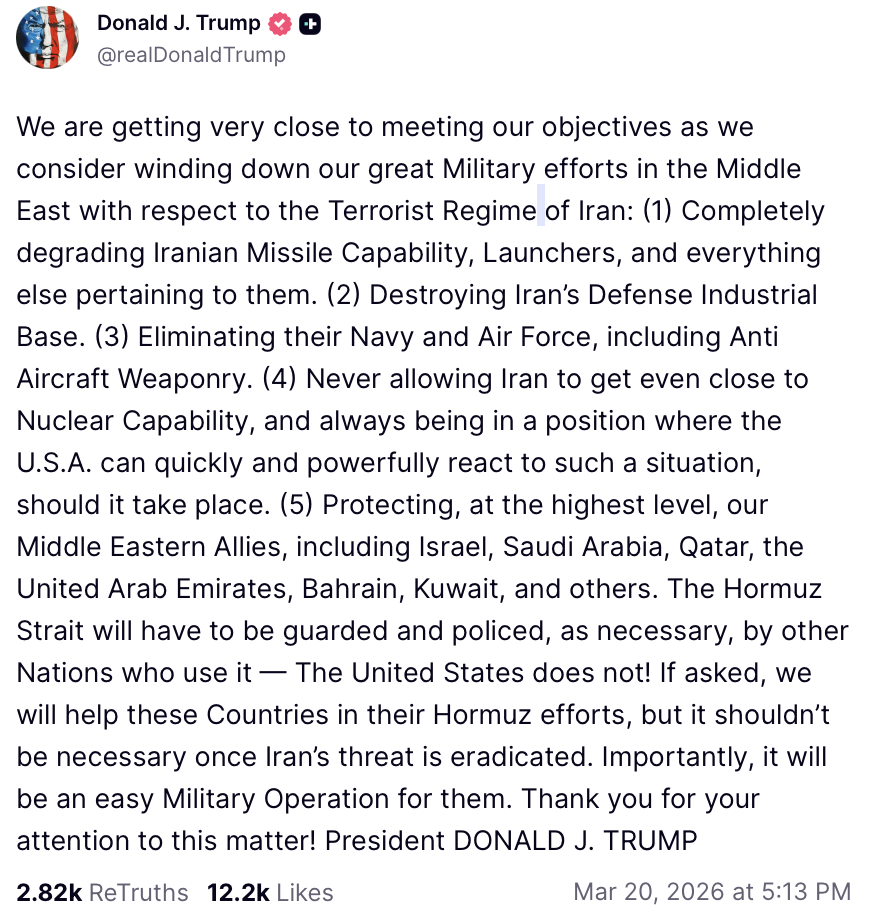
The President himself relays the positive developments of the war to the public. On Friday he announced that Washington’s objectives in the Iran war were very close to being met, which would put an end to the conflict.
Chief Defense Department spokesman Sean Parnell also issued a statement along these lines.
“Operation Epic Fury has been an overwhelming success, with our forces executing the mission with unmatched precision and achieving every objective set out from the beginning. Secretary of War Pete Hegseth is in constant communication with President Trump regarding every aspect of Operation Epic Fury. We are proud of the exceptional performance by our warfighters and remain fully confident in the commander-in-chief’s decisions.”
The White House press secretary Karoline Leavitt said Trump does learn about the negative developments in the war, not just the positive ones.
“That’s an absolutely false assertion coming from someone who has not been present in the room,” Leavitt said in a statement. “Anyone who has been present for conversations with President Trump knows he actively seeks and solicits the opinions of everyone in the room and expects full throated honesty from all of his top advisors.”
The offices of both the Director of National Intelligence Tulsi Gabbard and CIA Director John Ratcliffe have told NBC that Trump is given a full picture of the conflict, positive and negative. With that said, the President’s statements occasionally cross paths with inaccuracy.
Gabbard and Ratcliffe also testified that the White House received intelligence assessments before the war that, if it was struck, Iran would be likely to retaliate with attacks on energy sites in the Middle East and threaten commercial shipping in the Strait of Hormuz, with possible fallout for oil prices and the global economy. But Trump suggested last week that Iran’s reaction came as a surprise and that “no expert” predicted such a response.