 Image Credit: FREDERIC J. BROWN / Contributor / Getty Images
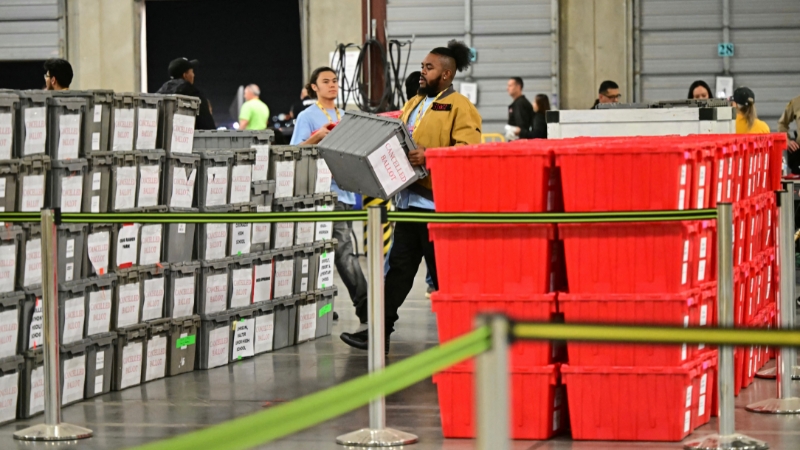
The US Supreme Court will rule on the legality of allowing mail-in ballots to be counted after election day.
The State of Mississippi is appealing a lower-court ruling that struck down its law providing a five-day grace period after election day to count mail-in ballots.
The law was enacted in July 2020, during the COVID-19 pandemic, to account for social disruption.
Supporters of the law claim it increases participation, while critics say it enables fraud and reduces trust in election integrity.
Eighteen states accept mail-in ballots after election day, so long as they contain a postmark dated on or before that day.
Part of the State of Mississippi’s argument in favour of upholding the law hinges on the potential nationwide changes that could be caused by striking it down.
Mississippi is being sued by the Republican National Committee, the Mississippi Republican Party and the Mississippi Libertarian Party, all of whom argue that the federal election-day statute pre-empts the state law.
US Codes Section 7 and 1 of Title 2, and Section 1 of Title 3 set the Tuesday after the first Monday in November in particular years as the election day for federal offices, with a presidential election every four years and a congressional election every two.
On 25 March last year, President Trump signed an Executive Order enforcing those statutes to “require that votes be cast and received by the election date established in law.”
A federal district court blocked part of that Executive Order in January.
Tom Fitton, president of Judicial Watch, said there has been a “contagion” spreading among the states in which they are “gutting the very notion of Election Day and allowing votes to arrive and be counted days and weeks after an election.”
“Your mailbox isn’t a ballot box,” Fitton told The Epoch Times.
“The idea that you drop your ballot in the mail and it gets there whenever, and it gets counted—that’s not the way it’s supposed to work.”
Judicial Watch represents the Libertarian Party of Mississippi, a co-respondent in the case.