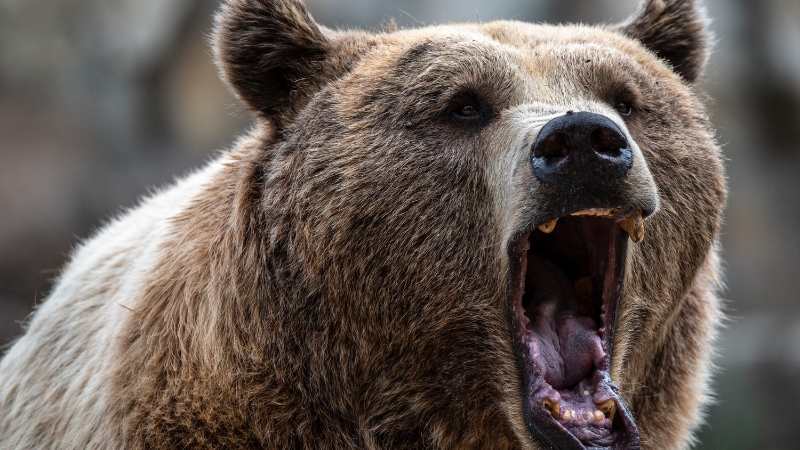
 Image Credit: Marcos del Mazo / Contributor / Getty Images
It’s widely accepted by linguists that the ancient Indo-Europeans—the forefathers of modern Europeans—simply would not say the word for “bear.” The word existed, yes, but they wouldn’t say it. In that regard, they’re actually not so different from Americans today. Let me explain.
One of the great achievements of nineteenth-century linguistics was to show that the various European languages all derived from a common ancestor, generally referred to as “proto-Indo-European.”
Words in modern European languages that designate the same thing, however different they may appear on the surface, can be traced back to a single master word.
Think of the modern European languages as the branches of a great big tree. Proto-Indo-European is the trunk and root system.
Proto-Indo-European was never written down, so these master words are reconstructions on the basis of inference and relationship between words across languages through time.
Often these reconstructed master words are strikingly familiar.
For example, the master word for “mother,” “mère,” “madre,” “mutter,” “matke” and so on has been reconstructed as *méh2-ter. (Just don’t pronounce the asterisk or the teeny little “2.”)
The master word for “bear,” however, is not recognizable—at least not if you’re a speaker of a Germanic or Slavic language.
The Proto-Indo-European master word for “bear” is *rkso-, from which derives the Latin “ursus” and the Ancient Greek “arktos.” The original meaning of these words is probably something like “destroyer.” Bears are destroyers, for sure.
But then there’s the English word “bear,” the Dutch “beer,” the German “baer”—all words that derive from the word for “brown.”
Rather than being “the destroyer,” the bear became “the brown one.” Bears are brown.
Slavic words for bear are slightly more poetic. The Russian “medved” and Polish “niedzwiedz” both mean something like “honey-eater.” Bears eat honey.
So why? Why focus on the bear’s color or his charming propensity to rummage through beehives and not his ability to rip off your limbs and eat your face?
Linguists think it might have something to do with the historical range of bears in Europe. Bears were once common throughout Europe, but their range contracted significantly from south to north in ye olden days, so that an encounter became significantly less likely if you were a Roman in a toga or an Ancient Greek reading Plato. The forest-dwelling Germans, by contrast, would still have encountered bears on a regular basis.
In short, the linguists believe, the use of euphemisms was a taboo, an act of reverence designed to ward off the very real possibility of an encounter with a creature that could, well, rip off your limbs and eat your face. The Roman and Greeks could afford to use the original term, or a derivation of it, because the thing it signified held only a distant terror. The Germans and Slavs, by contrast, could not.
And? What on earth has this got to do with anything? I’m glad you asked.
Like I said in the opening paragraph, Americans aren’t so different from the ancient Germans and Slavs. Americans also have a special taboo word and it must not be said, for reasons that are no more sensible or stupid than the much older ban on calling bears by their real names.
Of course I’m talking about the N-word.
Look at the case of Gary Edwards, a homeless black man who was cleared last week for stabbing a white man, because that white man said the N-word.
Fine, you might say, it’s not nice to call a black person the N-word. It’s not a wonder Mr Edwards lost his cool, is it?
First of all, I’d debate if it’s ever justified to stab someone because they said a racial slur, however much baggage the term may carry. A slap or a punch, sure—but a knife in the vitals? I don’t think so. I can’t remember the last time a Korean shanked someone for being called a “zipperhead” or a “slant,” or an Indian went on a flamethrower rampage for being slandered as a “pajeet” or a “poo in the loo.”
What’s so remarkable about this case though, is that it looks like the victim actually said the bad word after he was stabbed. He wasn’t stabbed because he said the N-word, yet somehow the word magically altered the time-space continuum and expunged the attacker’s bad intentions and with it the very serious crime he had obviously committed.
Tell me: Is there any other word that possesses such power to bend time and morality, to turn a crime into an act of self-defense after the act?
I can’t think of one.
There’s certainly no racial or ethnic slur for white people—“honky,” “cracker” “mayonnaise monkey,” “gweilo,” “gringo”—whose utterance could retroactively justify the stabbing of a black person by a white.
Imagine if Derek Chauvin had tried to argue his innocence by saying George Floyd had called him a “cracker.” Would he have walked free? (Derek Chauvin is innocent, by the way.)
And yet, if you’re black, it works. Just ask Gary Edwards.
There isn’t some grand point to this piece, except that America is an odd place and Americans have some strange views about race and what it does and doesn’t justify.
That white Americans are still subject to exceptions and lacunae that have the practical effect of making them second-class citizens in their own nation.
President Trump has done a huge amount, more than any other president in fact, to dismantle the vast apparatus of anti-white hatred and discrimination that’s been erected in American public life over the last seventy-odd years. He’s closed down the DoJ’s Community Relations Service and struck what are probably mortal blows to DEI and affirmative action. He’s made the US officially a pro-white nation for the first time—ever?—by giving refuge to Afrikaners fleeing racist persecution in South Africa and nobody else. That’s a big deal.
But one man can only do so much. Remember: It was a jury of his peers that let Gary Edwards off the hook. The word still has its magic; the taboo is very much still alive.
🚨WaPo / Democrats Caught In New Treasonous Hoax!!!🚨