 Image Credit: picture alliance / Contributor / Getty
Here are the most critical developments unfolding in the US-Iran conflict:
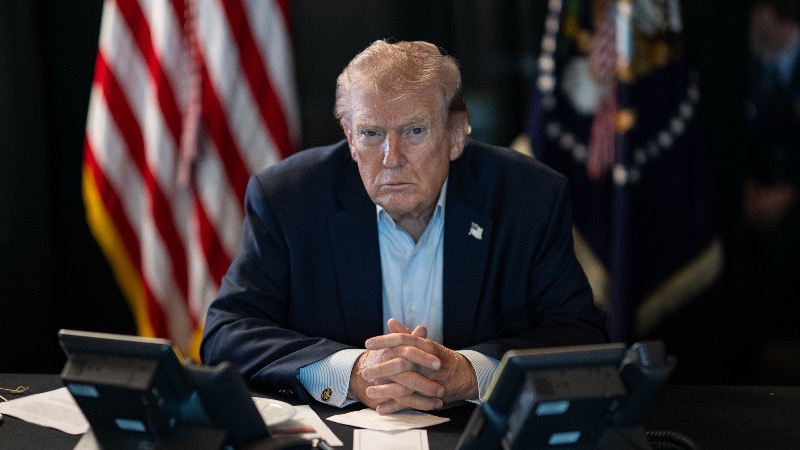
- Trump tries to articular war justification: says if we have a little high oil prices, could be for a little while, but they will drop, and could even be below the levels before, but that he ‘had to’ act or else Iran would have ‘used nukes’. Claims Israel didn’t force America’s hand. Admits leadership vacuum.
- US mulls offering military protection to ships in the Strait of Hormuz
- The Pentagon has released Operation Epic Fury’s objectives; 1- Demilitarization of Iran: destruction of its missile forces, production facilities, and naval fleet 2- Elimination of the terrorist regime 3- Protection of the United States from current and future threats 4- Ensuring that Iran does not possess nuclear weapons
- UAE mulling joining US-Israel attack on Iran, and the Saudis too, to stop Iranian missile and drone strikes on their countries.
- The American Embassy in Riyadh has been hit in another drone attack, with WSJ reporting it was struck twice Tuesday, resulting in damage to the roof. More embassies across region are shuttering, including the US Embassy in Beirut.
- President Trump mulling arming anti-Tehran militias. But he hasn’t decided yet while urging Iranians to rise up and be Washington’s ‘boots on the ground.’
- The Israelis just struck the meeting of the Iranian Supreme Council where officials were gathering to choose a new Supreme Leader, a senior Israeli official told Fox News. “Israel struck while they were counting the votes for the appointment of the supreme leader.”
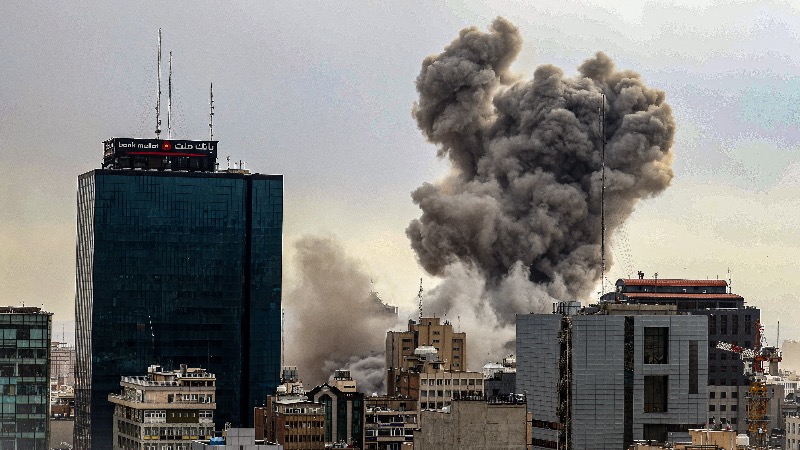
- US-Israel bombing is expanding inside Iran. Explosions heard in the northwestern cities of Tabriz and Urmia, as the capital no longer the only focus.
- Iraq’s crude oil output is being significantly curtailed. An update from Iraq specifies a shutdown of 460,000 bpd at West Qurna 2 and a cut of 700,000 bpd at Rumaila, while warning that more than 3 million bpd could be forced offline in the coming days if tanker access remains limited.
- Export crude bottlenecks are developing across Iraq. Storage at southern export terminals is nearing critical capacity because tanker traffic in the Strait of Hormuz has been paralyzed. Iraq has also halted most Kurdistan-to-Turkey exports via Ceyhan, leaving only about 50,000 bpd for domestic use.
- Iranian retaliation expanded on Tuesday, with Gulf states’ energy infrastructure hit by multiple drones. This included a drone strike on Fujairah in the UAE, a key bunkering and crude-loading hub outside the Strait of Hormuz, as well as a drone strike at the Port of Salalah in Oman.
- The U.S.-Israeli operation against Iran is intensifying. Strikes are said to be hitting major targets, including state media, military command sites, and leadership compounds, with the reported Iranian death toll rising to 787 since the start of Operation Epic Fury.
- The war is spreading into a broader regional conflict. Israel has expanded attacks into Lebanon, including renewed strikes on Beirut and a ground move into the south, while regional actors such as Qatar and possibly Saudi Arabia are portrayed as being drawn more directly into the conflict.
- France sending aircraft carrier to Mediterranean, says Macron
* * *
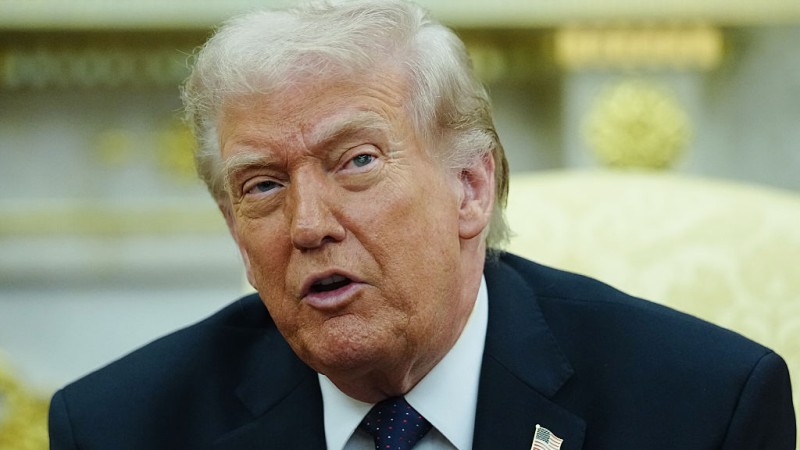
Update(12:45ET): To quote Rumsfeld there are many “unknowns” as the Iraq Iran war continues to go regional, but a Tuesday Oval Office press conference saw Trump try and articulate war justifications. A quick summary:
President Trump spoke at the White House alongside visiting German Chancellor Friedrich Merz, declaring the military campaign against Iran a decisive success. “We’re doing very well,” Trump said.
“They have no navy; it’s been knocked out. They have no air force; it’s been knocked out. They have no air detection — that’s been knocked out,” he stated, adding that Iran’s radar systems and “just about everything’s been knocked out.”
Pressed in the Oval Office on why there was no evacuation plan for Americans in the Middle East before Saturday’s strikes, Trump said, “Well, because it happened all very quickly.”
“I thought we were going to have a situation where we were going to be attacked. They were getting ready to attack Israel,” he said.
When asked whether Israel had “forced” his hand, Trump replied, “No, actually, I might have forced their hand.”
Addressing speculation about Iran’s future leadership, Trump referenced Reza Pahlavi. “He seems like a very nice person. But it seems to me that someone from within might be better” to take over, he said.
Trump acknowledged the risks of regime change. “I guess the worst case would be, we do this, and then somebody takes over who’s as bad as the previous person, right?” he said. “That could happen. We don’t want that to happen.”
Defending the timing of the strike, Trump said, “You see, we were having negotiations with these lunatics, and it was my opinion that they were going to attack first. They were going to attack. If we didn’t do it, they were going to attack first. I felt strongly about that.”
And finally: very GW Bush style…
If we hadn’t attacked Iran, it would have already started a nuclear war with many countries, because “they are pure evil and sick in the head” – Trump.
Update(11:15ET): American or regional officials have confirmed that the US Embassy in Riyadh has come under drone attack twice on Tuesday resulting in the roof suffering a partial collapse.
Part of the building is engulfed in smoke, with staff said to be sheltering in place. An earlier State Dept statement said: “Embassy Riyadh has been struck by two UAVs that hit the roof and the perimeter of the chancery.” The cable added: “Post is sheltering in place and reported no injuries.” Initial reports say no casualties, according to a person familiar with the incident. Meanwhile…
Saudi Arabia condemns ‘flagrant’ Iranian drone attack on US Embassy in Riyadh – Al Arabiya English
Scenes from on the ground in Tehran:
Update(0920ET): In a massive though not completely unexpected development, Iraq has shut down 460,000 barrels per day of production at the West Qurna 2 field, Iraqi oil officials told Reuters. Officials warned the country will be forced to cut more than 3 million barrels per day within days if oil tankers cannot move freely and access loading terminals, as confirmed in Bloomberg.
On Tuesday, Iraq reduced output at the Rumaila oil field by 700,000 barrels per day. Rumaila is the second-largest oil field in the world, and storage levels at southern export terminals have reached critical capacity due to disruptions and slowdowns in tanker traffic through the Strait of Hormuz, according to local officials.
Importantly, Iraq also halted crude exports from its semi-autonomous Kurdistan region through the key pipeline to Turkey’s port of Ceyhan, according to sources cited by Bloomberg. Roughly 200,000 barrels per day have been shut in as producers cut output amid escalating regional conflict. Only about 50,000 barrels per day are now being produced for domestic use.
Energy infrastructure in northern Kurdistan has faced repeated attacks during prior unrest. And now with major fields throttling output and exports constrained, oil prices are surging.
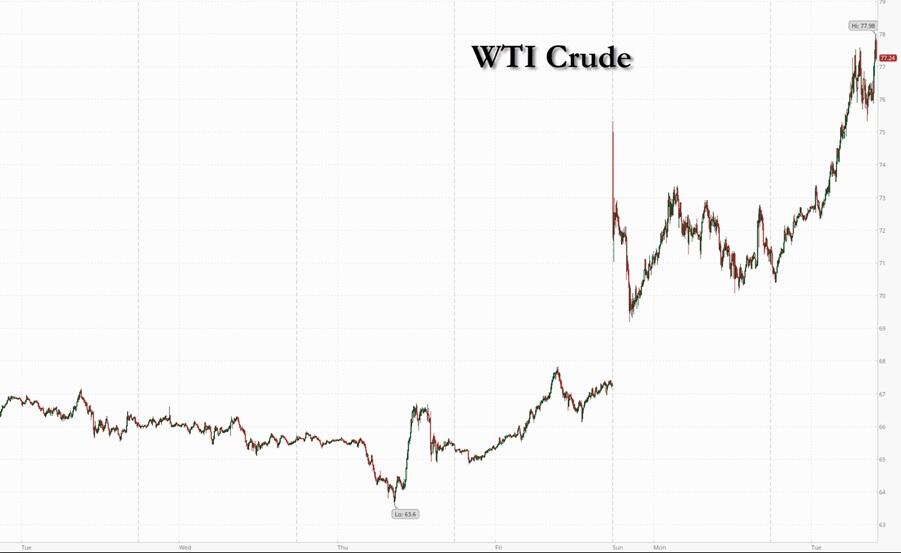
Targeting Gulf production from across water in Iran….
Israeli and US forces pressed forward with their assault on Iran, striking targets across the country, including Iran’s state broadcaster and central military command centers, as the official death toll has climbed to 787 Iranians killed since the start of the Trump-ordered Operation Epic Fury. The US has sustained at least six troop deaths and several more seriously wounded.
Fears that this could open to a broader multi-front war appear to be coming to reality, as at the same time Israel escalated operations on a second front, intensifying airstrikes on Lebanon and launching a new ground incursion into the south. Beirut is once again under Israeli bombs, after Israel accused Hezbollah of firing rockets on the north. What’s more is that Kann News is citing a senior Israeli official as follows: We assess that Saudi Arabia will attack Iran soon after it was attacked yesterday. The war is expanding.
The conflict has continued to spread across the Gulf. Saudi authorities said two drones struck the US Embassy in Riyadh, igniting a small fire and causing minor damage. However, there’s been surprisingly little information or video to come out of this major incident.
Qatar has formally joined the war on the US-Israeli side, having already said it took out a pair of Iranian jets. The tiny oil and gas rich GCC country Foreign Ministry stated that “the two Iranian planes shot down by Qatar yesterday were flying toward Doha and were warned before being shot down. Qatar is searching for the pilots.”
Iran has continued its retaliation by targeting energy infrastructure across the Gulf, driving global oil and gas prices sharply higher. As we reported previously, Qatar’s state-owned petroleum company suspended all LNG production after two of its facilities were hit.
The status of the vital Strait of Hormuz remains a big unknown, with Iran’s Revolutionary Guard Corps (IRGC) announcing that the vital oil transit chokepoint for roughly one-fifth of global oil consumption is now “closed”. While the consensus is that after the US blew up all or most of the Iranian Navy’s vessels, it doesn’t have the maritime power to effect a blockage, the IRGC can certainly wreak havoc through its drone and missile arsenal.
Iran has also continued missile attacks on Israel, with the Israeli military reporting interceptions over West Jerusalem, Tel Aviv, and Eilat. At least 10 people have been killed in Israel since Saturday. Many dozens, possibly in the hundreds, have been injured and wounded. Fox live shots and correspondent on the ground Trey Yingst have been offering proof that Israel’s anti-air defenses are routinely being overwhelmed and significant impacts have resulted.
Costly interceptors are also being expended at a high rate across the Gulf, and these countries are urgently appealing for more from Washington, but they will soon be in short supply at this rate. The Wall Street Journal warns as follows:
Persian Gulf nations targeted by Iran have, so far, managed to limit the damage by deploying sophisticated U.S.-made air defenses against the hundreds of drones and missiles that have rained on their cities.
With costly interceptors and radar, all integrated with the U.S. military, the oil-rich Gulf Arab states have fielded some of the most advanced air defenses in the world, despite their small populations and militaries.
A crucial variable in this war, however, is whether these monarchies start running out of interceptors before the Iranian regime runs out of projectiles. At current burn rates, it could be very soon.
Alarmingly, initial White House talking points of a ‘limited’ campaign of mere days (and based on pre-war comments during the build-up) have now gone out the window as on Monday President Trump and Secretary Rubio indicated the operation could run for roughly four or five weeks. But they also admitted there’s a basically open-ended timeline to “do whatever it takes” to eliminate Tehran’s missile and nuclear capabilities, and to destroy the country’s missile arsenal.
But then here’s what the Trump administration failed to take into account, or perhaps chose to completely ignore. Trita Parsi told The Economist:
“This is not a monarchy in which the shah is gone and you take out all of the male heirs.” He explained: “This is a system—not a particularly popular system—but nevertheless one with a security establishment that is not dependent on a single person or a single family.”
Pentagon brass doesn’t seem to know what the plan is, how long it will last, or why they’re there: “The hours, days, and perhaps weeks ahead will challenge you. There will be noise and confusion.”
There are reports that in the instance of the Ayatollah’s death under US-Israeli bombs, which is the first thing that happened Saturday as he was apparently not in hiding, Iran put a strict emergency protocol in place. This reportedly involved plans for the IRGC and various military units across the country to begin acting autonomously within their respective chains of command, so that a state decapitation strike won’t disrupt the ongoing retaliation.
That retaliation has already killed at least six US service members stationed at Gulf bases:
The U.S. is facing increasing risks to its military forces and diplomatic presence in the Middle East as Iran is launching waves of missile and drone attacks across the region that are testing its ability to defend a swath of territory.
U.S. Central Command said that six servicemembers had been killed in the three-day-old campaign on Monday. The six died in a drone strike on a base in Kuwait, The Wall Street Journal reported. Separately, three American F-15 jets were downed by apparent friendly fire over Kuwait on Monday, in one of the most significant losses of equipment for the U.S. in the operation.
Bases that house U.S. forces have also come under attack in Iraq, Saudi Arabia and Bahrain.
In at least one instance troops were in a mobile trailer which served as a makeshift command center or office when an Iranian projectile hit.
The White House has meanwhile said it is not at all in diplomatic contact with the Iranians, who may want to impose a deeper cost before even starting a discussion for an offramp – and it’s the same with the Gulf states – there doesn’t seem to be any top-level contact.
Rubio and Hegseth have kept repeating that “this is not Iraq” and have insisted this is not another Neocon “endless war”. They might be right in that what just opened up might prove far worse than the Iraq war. So far there’s no US boots on the ground that we know of, but we’re already at that admin talking point of ‘we haven’t ruled it out’. White House leadership has also been surprisingly open as to Israel’s role in the US decision to attack Iran.
More latest headlines via Newsquawk:
- Israeli defence forces announce that they did not deploy ground troops in Iran, Israeli source report.
- The IDF announces that they have struck Iran’s leadership compound in Tehran.
- IAEA confirms recent damage to entrance buildings of Iran’s underground Natanz fuel enrichment plan.
- Israel’s Home Front announce early warning after detection of rockets fired from Iran toward Israel, Al Jazeera reported.
- Israeli Military Spokesperson said it is not likely that Israel will deploy ground forces to Iran as it is not practical.
- IDF spokesperson said launches detected from Iran and alerts expected in the northern area from the Golan to northern Sharon.
- Iran’s military said it targeted the Al Udeid base with missiles.
- Iran’s IRCG said they targeted the aircraft carrier “Lincoln” with 4 cruise missiles; The aircraft carrier “Lincoln” headed towards the southeastern Indian Ocean , Al Arabiya reported.
- Member of Iran’s Assembly of Experts said choosing a successor to Supreme Leader Khamenei “won’t take long”, according to ISNA.
- Hezbollah said it targeted the Ramat David Air Base in northern Israel.
- US VP Vance said President Trump wants to make sure Iran never had nuclear weapons, adds the US has a lot of capacity in Iran.
- US President Trump held a call with Kurdish leaders in Iraq on Sunday to discuss the US-Israel war with Iran and what might come next, according to three sources with knowledge of the called cited by Axios.
- US is said to prepare for a ‘pickup’ of attacks in Iran during the next 24 hours, according to CNN.
Get your bottle of Ultra Methylene Blue now! Plus, try our new Electrolyte Drink Mix, the Mind Fuel Energy Drink, our popular America Supply Company Patch Hat, the latest Infowars tactical dagger and Bovine Methylene Blue Tallow Balm by visiting TheAlexJonesStore.com where every dollar you spend gets you entered into a giveaway for a 2020 Ford Mustang Shelby GT 500!