 Image Credit: Anton Petrus / Getty
Ever since the Renaissance sparked off a surge in international (and indeed global) relations, world orders came and went, but always persisted. Each global order is headed up by a nation which is able to exert military control over international shipping, political influence over international commerce and perhaps most importantly, hold the world reserve currency.
These periods appear inextricably linked to the sociological phenomenon of The Fourth Turning – a recurring generational cycle in Western society where historical events are associated with generational archetypes, each lasting around 21 years, in which a new social, political, and economic climate exists.
After four of these generations, the system dissolves and a new system is born during the ensuing fifth generation. Thus, world orders last (on average) about 100 years. A rundown of previous world orders (based on global reserve currencies) are as follows:
- Portugal: 1450 to 1530
- Spain: 1530 to 1640
- Holland: 1640 to 1720
- France: 1720 to 1815
- Britain: 1815 to 1920
- United States: 1920 to today
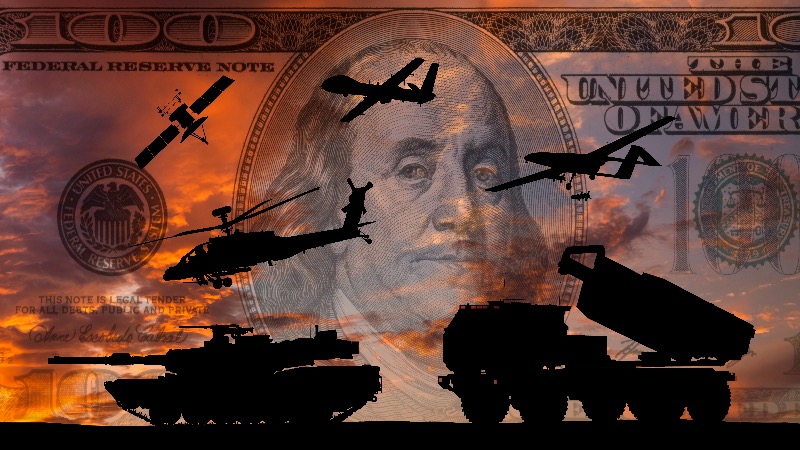
World reserve currency status goes hand-in-hand with military power. While military power begins to come into question, so does financial power.
A March 23 commentary article in Fortune magazine analyzed the Treasury Department’s consolidated financial statements for fiscal year 2025 which were released the previous week. The numbers were alarming. The official balance sheet liabilities plus the off-balance-sheet obligations equal $136.2 trillion, which is about five-times the annual gross domestic product. Based off these numbers, the authors concluded that the U.S. is insolvent.
Professor of international business at Columbia Business School, Pierre Yared, and associate professor of public policy at University of Chicago, Carolin Pflueger, authored the research paper “Global Hegemony and Exorbitant Privilege” in November 2025 which detailed the link between financial and military strength in global hegemony.
“We present a dynamic two-country model in which military spending, geopolitical dominance, and government bond prices are jointly determined. The model reflects three facts: hegemons enjoy a funding advantage, this advantage rises with geopolitical tensions, and war losers devalue their debts more. In the model, greater bond revenue enables military investment, in turn increasing the safety value of bonds to international investors. Debt capacity strengthens the hegemon’s military and financial advantage but introduces steady-state multiplicity and fragility. With intermediate capacity, initial conditions determine the hegemon. However, with high capacity, self-fulfilling bond market expectations can trigger hegemonic transitions and geopolitical fragility,” the research paper said.
The Atlantic Council strategy paper “A Strategy For Dollar Dominance” authored by Martin Mühleisen and Valbona Zeneli from May 2025 also detailed the financial/military relationship which forms the foundation of the global order.
“Over the past eight decades, the status of the United States as an economic and geopolitical superpower and the role of the US dollar as the world’s dominant currency have reinforced each other. As a synonym for the dollar’s preeminent role in international currency transactions and foreign reserve holdings, dollar dominance has long been associated with the United States’ exorbitant privilege to finance large fiscal and current account deficits at low interest rates. This has helped the United States run a large defense budget and conduct extensive military operations abroad. In turn, the United States has used its military capabilities to support the free flow of goods and capital across the globe, boosting global growth while providing investors with confidence that investments in US financial instruments are secure. This virtuous cycle contributed to the long-lasting stability of the post-World War II international order, leading to a sustained rise in economic welfare in the United States and around the world,” the strategy paper said.
The article “How Did the United States Become a Global Power?” from February 2026 published by the Council on Foreign Relations chronicled how the U.S. assumed control of the current global order through the Spanish-American War, World War I and World War II.
The 2017 article “Maritime Strategy in a New Era of Great Power Competition” by Seth Cropsey and Bryan McGrath published in The Hudson Institute discussed how Russia and China are encroaching on the U.S.-controlled global order.
On Monday The Atlantic published the article “Trump Is Putting America’s Weaknesses on Display” by Phillips Payson O’Brien which analyzed the changing position of the U.S. in the global order following events in the Iran war.
“President trump is stuck. Before he authorized a bombing campaign against Iran, his administration failed to plan for the possibility that Iranian forces would close the Strait of Hormuz. With no good options, Trump has been left to hope that the crucial shipping channel will “open up naturally.” Although Iran is far smaller and poorer than the United States, and many of its top officials have been killed in the past month, its remaining leaders are exercising considerable leverage over Trump and, at least publicly, are ignoring his demand for negotiations,” the article said. “U.S. forces continue to carry out tactically complex operations, such as the rescue of an airman who ejected from a doomed fighter jet over Iranian territory. But far from resulting in a quick victory against an overmatched rival, Trump’s war in Iran is putting America’s strategic and military weaknesses on display for other rival nations—most notably China, the world’s other great military and economic power. Yet by revealing that the United States has not adapted enough to the latest changes in how military conflicts are fought, recent events could well alter Beijing’s risk-benefit calculations about, for instance, seizing Taiwan.”
On Thursday talkshow host Tucker Carlson discussed the end of the American empire in a video monologue. He explained how events in the Iran war, such as Washington’s inability of keeping the Strait of Hormuz open, have demonstrated to the world that the U.S. no longer controls the global order.
Carlson referred to the Iran war as a world war, in that each country’s future is determined by the outcome of the conflict. The winner will be determined by who can bring order to the chaos, thus organizing the future global economy.
“You’ll know who’s in charge by who settles the conflict,” Carlson said.
U.S. energy producing allies in the Gulf region (Qatar, Kuwait, Bahrain, United Arab Emirates and Saudi Arabia) have discovered that they are not protected by the U.S. military after absorbing Iranian missile barrages which have disrupted their energy production abilities – the industry their economies are based upon.
America’s Asian allies (Japan, South Korea and Taiwan) have discovered that the U.S. is unable to exert its military power to maintain the Gulf energy exports which feed Asian manufacturing abilities – the industry their economies are based upon.
Carlson said the phenomenon of the U.S. losing dominance over the global order is best documented by President Donald Trump’s post on March 31 which directed the rest of the world to deal with the issue of facilitating Gulf energy transit through the Strait of Hormuz:
All of those countries that can’t get jet fuel because of the Strait of Hormuz, like the United Kingdom, which refused to get involved in the decapitation of Iran, I have a suggestion for you: Number 1, buy from the U.S., we have plenty, and Number 2, build up some delayed courage, go to the Strait, and just TAKE IT. You’ll have to start learning how to fight for yourself, the U.S.A. won’t be there to help you anymore, just like you weren’t there for us. Iran has been, essentially, decimated. The hard part is done. Go get your own oil! President DJT
Carlson explained how this directive from Trump is not exactly intended for Europe, as European militaries are substantially weaker than the U.S military, as has been the case in the post-WWII U.S.-dominated world order. Trump’s post is likely directed toward China and Russia – nations that already have a close relationship with Iran, both financially and militarily.
On Friday Trump said that the U.S. could easily open the strait, although it has not yet proven this ability:
With a little more time, we can easily OPEN THE HORMUZ STRAIT, TAKE THE OIL, & MAKE A FORTUNE. IT WOULD BE A “GUSHER” FOR THE WORLD??? President DONALD J. TRUMP
Regardless of Trump proclaiming the ability to open the strait, likely for a political narrative, the only thing that matters in the end is actually opening the strait. If China and Russia eventually gain control via bringing order to the chaos, they will organize the future economy in their region. This region incudes current U.S. allies in the Gulf and U.S. allies in Asia.
Importantly, the region that China and Russia are likely to gain dominance over is the region near their borders, the Eastern Hemisphere. The U.S. will likely react by pivoting back to the Western Hemisphere.
Thus spheres of influence are likely to be more geographically centralized, instead of the globalized economy that has characterized the last 80 years.
This is actually touched upon in Trump’s White House National Security Strategy.
“After years of neglect, the United States will reassert and enforce the Monroe Doctrine to restore American preeminence in the Western Hemisphere, and to protect our homeland and our access to key geographies throughout the region. We will deny non-Hemispheric competitors the ability to position forces or other threatening capabilities, or to own or control strategically vital assets, in our Hemisphere. This ‘Trump Corollary’ to the Monroe Doctrine is a common-sense and potent restoration of American power and priorities, consistent with American security interests,” the document said. “Our goals for the Western Hemisphere can be summarized as ‘Enlist and Expand.’ We will enlist established friends in the Hemisphere to control migration, stop drug flows, and strengthen stability and security on land and sea. We will expand by cultivating and strengthening new partners while bolstering our own nation’s appeal as the Hemisphere’s economic and security partner of choice.”
Despite the likely (if not inevitable) future of U.S. allies in the Middle East and Asia growing closer to China and Russia, nations in the Americas will likely grow closer to the U.S., which is not a bad situation.
Carlson discussed the resource-rich Western Hemisphere. The U.S. possesses prime farmland and natural gas, Canada and South America possess vast mineral and energy resources. The future will likely see Washington care more about Brazil than Bahrain.
The Iran war is destroying globalization that’s based on the post-WWII American empire.
In the short term, losing control of the global order is bad, as it results in a national humiliation. In the long term it can have some serious perks, however.
“So that’s going to be hard for some people to accept. It may be dispiriting to us as a nation. But it reflects reality, and it’s not the end of American power or prosperity,” Carlson said. “It might in fact be the beginning of actual power and more durable prosperity. The kind rooted in resources and production. The kind that’s not necessarily dependent on finance. So it doesn’t need to be a disaster, but it’s definitely going to be a global reshuffling.”
Losing the position it has maintained since the end of WWII refocuses the U.S. national interest inward. Mexican drug cartels, Canadian euthanasia programs, Brazilian communist dictatorships and American homelessness will likely face renewed national scrutiny when issues near to home take center stage as the old role of global policeman gets stripped from Washington.
The geopolitical and financial era that is coming to a close is also marked by its own spiritual era which is dying along with it. Carlson discussed how the American Protestant movement has gone so far from what it was before WWII that it is unrecognizable, and unsustainable.
“We just happen to have the misfortune, or the great luck, to be living in the middle of the moment where these great institutions and the expectations that come along with them are dying, right in front of us, right now,” Carlson said. “And that’s sad, it’s hard to watch, it will affect your sleep if you think about it too much but it’s also a prerequisite, it is a necessary step…to rebirth.”