 Image Credit: JIM WATSON / Contributor / Getty
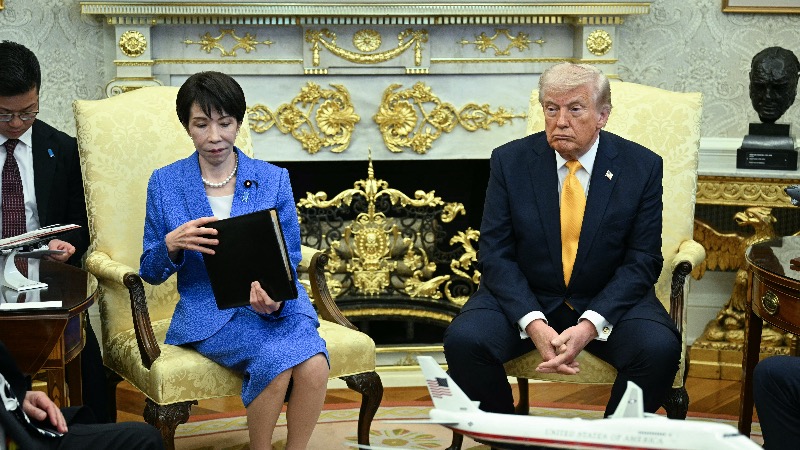
On Thursday President Donald Trump and Japanese Prime Minister Sanae Takaichi met at the White House where they announced a roughly $40 billion collaboration to build advanced small modular nuclear reactors (SMRs) in the United States. Thursday’s deal builds upon a previous agreement between the two nations.
The power-generation technology could offset energy setbacks due to the ongoing Iran war.
Tennessee and Alabama will be host to sites operated by U.S.-based GE Vernova Inc. and Japan-based Hitachi Ltd. that aim to “stabilize electricity prices, expand power generation and bolster energy security amid global tensions,” according to officials.
Thursday’s developments build upon the $550 billion American/Japanese Technology Prosperity Deal from October “which commits significant capital to U.S. energy technologies, including nuclear reactors, power plant and grid components, and critical minerals,” the Center for Strategic and International Studies said.
In February Trump elaborated on the initial trade deal:
The initial investment was chronicled by the Center for Strategic and International Studies at the time:
The joint fact sheet released last week included up to $100 billion each for Westinghouse and GE Vernova Hitachi to construct nuclear reactors, $25 billion each for Bechtel and GE Vernona for power equipment and services, and another $25 billion for Carrier for cooling systems. NuScale and ENTRA1 were also mentioned in the joint fact sheet, though no specific dollar amount was designated. In total, Japan is expected to invest $550 billion before President Trump’s term ends in 2029.
Thursday’s meeting went viral after President Trump made a strange comment to Prime Minister Takaichi which implied the 1941 Japanese attack on U.S. naval assets in Pearl Harbor Hawaii was a “surprise.”
This comment, or joke, is factually inaccurate as Washington knew days before that the Japanese were about to attack, but chose to do nothing in order to drag the U.S. into WWII.
“We went in very hard and we didn’t tell anyone about. Who knows better about surprise than Japan? Why didn’t you tell me about Pearl Harbor, ok?” Trump said awkwardly to Takaichi. “You believe in surprise I think much more than us.”
In addition to the fact that Washington knew of Tokyo’s attack before it took place, Alex Jones knew of Israel and Trump’s attack on Iran before it took place, despite Trump’s claim that it was a “surprise” attack. Jones’ show headline directly before the operation against Iran began was “Trump Has Reportedly Given The Green Light To Strike Iran.”
Trump’s inaccurate statements may however be rooted in thought processes far deeper than a lack of knowledge – the act of deceit. The Brookings Institute published a white paper in 2009 detailing how purposefully failed negotiations could be used to publicly justify a war against Iran.
The Prime Minister went on to laud the President’s actions, saying only he can bring peace to the world, she condemned Iran’s nuclear ambitions and called for de-escalation in the war, but also explained how she is unable to (due to constitutional limits) join in on the military conflict with the U.S. – Trump was hoping for more support despite saying he doesn’t need help after his first global request was denied by his allies and trade partners.
“I expect Japan to step up because, you know, we have that kind of relationship and we step up for Japan,” Trump said at Thursday’s meeting. “We don’t need much. We don’t need anything. I mean, honestly, we don’t need anything from Japan or from anyone else. But I think it’s appropriate that people step up.”
Japan is likely to feel the effects of the Iran war on their energy sector even more than the U.S., as energy transport through the Strait of Hormuz is a major part of the Japanese energy mix.
“Japan gets 95 percent of its crude oil supplies from the Gulf,” U.S. Treasury Secretary Scott Bessent told Fox Business on Thursday ahead of the meeting. “I would expect that they would want to ensure its supplies are safe.”
Embed from Getty ImagesImage credit: US President Donald Trump meets with Japan’s Prime Minister Sanae Takaichi in the Oval Office of the White House in Washington on March 19, 2026. Also pictured, US Vice President JD Vance (2R) and US Secretary of State Marco Rubio (R). (Photo by Jim WATSON / AFP via Getty Images)
“She [the Prime Minister] also said the global economy was about to take a hit due to the turmoil in the Middle East,” Reuters said.
Japan may prove to be a key factor in future U.S./Iranian negotiations. Tokyo maintains diplomatic relations with Tehran, making for a potential avenue of talks to help end the war.
Takaichi also told Trump that Japan plans to join the “Golden Dome” anti-missile system, which is notable due to Japan’s location on the globe – off the coast of China and Russia.
ZeroHedge went in-depth with some of the interactions from Thursday’s White House meeting:
Trump praised Takaichi repeatedly, calling her “a very popular, powerful woman” and “a great woman” after her recent landslide election win. He expressed particular delight when she spoke English directly, noting it was “so nice that we don’t have to sit through that [translation].” Takaichi reciprocated warmly, addressing him as “Donald” and stating, “I firmly believe it is only you, Donald, who can achieve peace across the world,” while condemning Iran’s nuclear program and actions in the Strait of Hormuz, though urging de-escalation.
On the security front, Japan held firm on constitutional limits, with Takaichi explaining what her country “can and cannot do” militarily—no warships were committed to Hormuz despite Trump’s earlier pushes for allied naval support. Broader discussions covered trade implementation, critical minerals, Indo-Pacific stability, defense cooperation, and countering China.
As noted below on the nuclear deal – GE Vernova and Hitachi, under their existing joint venture GE Vernova Hitachi Nuclear Energy (GVH), will construct BWRX-300 small modular reactors (SMRs) in Tennessee and Alabama, with the projects valued at up to $40 billion. Specific timelines for operation remain under wraps, but the deal highlights accelerating momentum for advanced nuclear technology.
This announcement follows the first tranche of commitments under the fund, which we covered in detail last month. Those initial projects totaled $36 billion and focused on a massive natural gas facility in Ohio, a synthetic diamond plant in Georgia, and a Gulf Coast crude export terminal.
The topic that was most notable and of substance between Trump and Takaichi revolved around the industrial investment in energy sector technologies. ZeroHedge detailed these systems:
The BWRX-300 units, each roughly 300 MW, are designed for faster factory-built deployment than traditional gigawatt-scale plants. Sites in Tennessee tie into the Tennessee Valley Authority’s Clinch River development, while Alabama locations will partner with private developers. No SMRs currently operate on U.S. grids, but the Trump administration has prioritized regulatory streamlining and federal support to shorten timelines that have historically stretched a decade or more.
We previously covered the U.S.-Japan trade deal and the surrounding agreements back in October of last year when investments worth over $500 billion were pledged by Japan. At the time, the announced value of investments for GE Vernova reactors was $100 billion, so this barely represents even half of that previously announced commitment. It remains unknown where the other $60 billion will be directed to.
There are also outstanding commitments from Japan to support NuScale with up to $25 billion, and Westinghouse with an additional $100 billion. The $100 billion for Westinghouse will most likely be in the form of funding the $80 billion agreement between the U.S., Cameco, and Brookfield for 10 AP1000s.
Alex Jones Predicts The 9/11 Inside Job Terror Attacks In July 2001