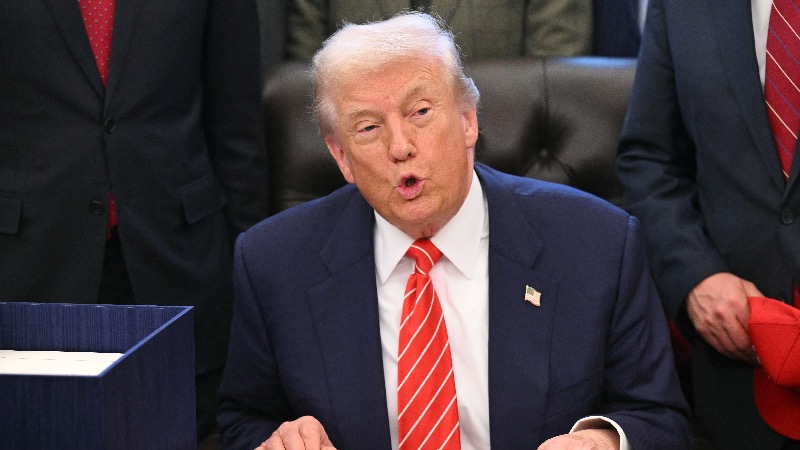
 Image Credit: SAUL LOEB / Contributor / Getty
On Thursday President Donald Trump described his peace-through-strength strategy with the U.S. military, detailed his first-term accomplishments in this sector and announced that he will be seeking the creation of a new and improved nuclear arms reduction treaty following the sunset of the New START Treaty on Wednesday.
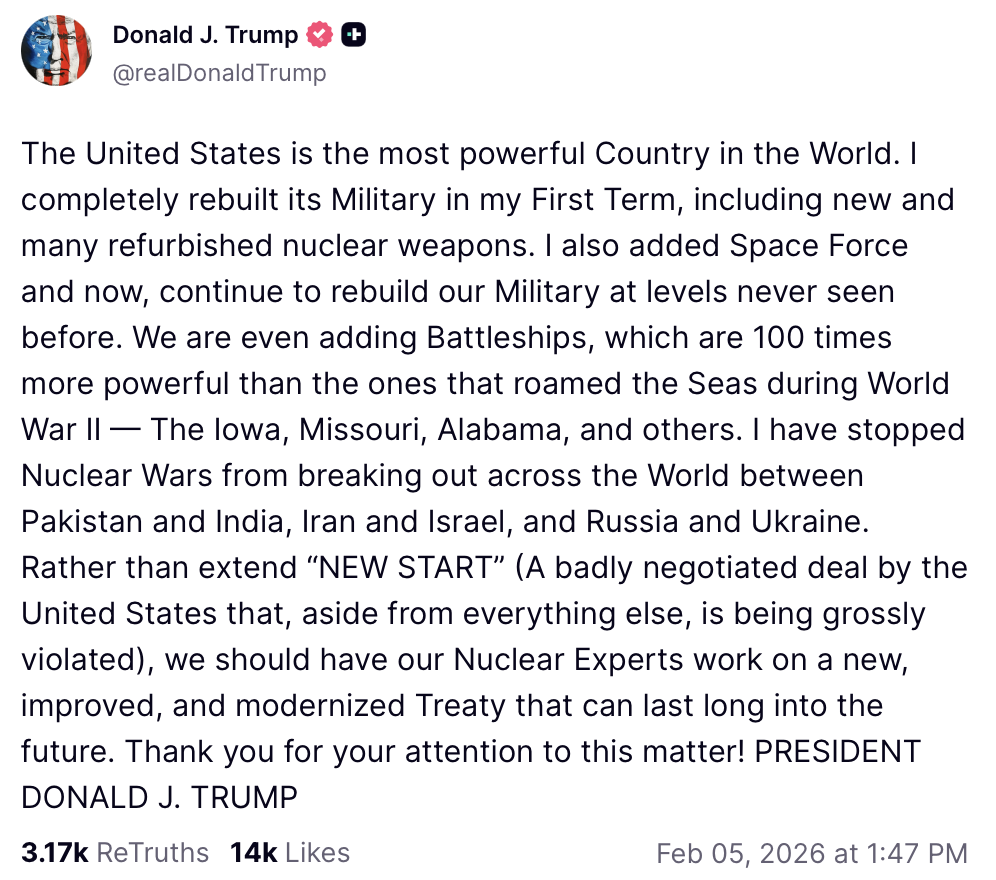
The United States is the most powerful Country in the World. I completely rebuilt its Military in my First Term, including new and many refurbished nuclear weapons. I also added Space Force and now, continue to rebuild our Military at levels never seen before. We are even adding Battleships, which are 100 times more powerful than the ones that roamed the Seas during World War II — The Iowa, Missouri, Alabama, and others. I have stopped Nuclear Wars from breaking out across the World between Pakistan and India, Iran and Israel, and Russia and Ukraine. Rather than extend “NEW START” (A badly negotiated deal by the United States that, aside from everything else, is being grossly violated), we should have our Nuclear Experts work on a new, improved, and modernized Treaty that can last long into the future. Thank you for your attention to this matter! PRESIDENT DONALD J. TRUMP
New START limited the number of deployed nuclear weapons between the U.S. and Russia. The State Department detailed this now-former international agreement:
Treaty Structure: The Treaty between the United States of America and the Russian Federation on Measures for the Further Reduction and Limitation of Strategic Offensive Arms, also known as the New START Treaty, enhances U.S. national security by placing verifiable limits on all Russian deployed intercontinental-range nuclear weapons. The United States and the Russian Federation have agreed to extend the treaty through February 4, 2026.
Strategic Offensive Limits: The New START Treaty entered into force on February 5, 2011. Under the treaty, the United States and the Russian Federation had seven years to meet the treaty’s central limits on strategic offensive arms (by February 5, 2018) and are then obligated to maintain those limits for as long as the treaty remains in force.
Aggregate Limits
Both the United States and the Russian Federation met the central limits of the New START Treaty by February 5, 2018, and have stayed at or below them ever since. Those limits are:
- 700 deployed intercontinental ballistic missiles (ICBMs), deployed submarine-launched ballistic missiles (SLBMs), and deployed heavy bombers equipped for nuclear armaments;
- 1,550 nuclear warheads on deployed ICBMs, deployed SLBMs, and deployed heavy bombers equipped for nuclear armaments (each such heavy bomber is counted as one warhead toward this limit);
- 800 deployed and non-deployed ICBM launchers, SLBM launchers, and heavy bombers equipped for nuclear armaments.
The President appears to be interested in furthering global denuclearization past New START instead of kicking the can of atomic stalemate down the road. The Kremlin’s offer of a temporary plan to replace New START was not taken up by the White House.
“Russian President Vladimir Putin on Monday has offered President Trump a temporary nuclear arms control deal that would extend the status quo by one year, at a moment the future of the New Strategic Arms Reduction Treaty, or New START, is hanging by a thread,” ZeroHedge reported in September.
“I have stopped Nuclear Wars from breaking out across the World between Pakistan and India, Iran and Israel, and Russia and Ukraine,” The President said Thursday.
Trump indeed stepped into his second term and deescalated a situation that was heading toward global nuclear conflict. The President hasn’t shied away from discussing the U.S. nuclear arsenal however. In October 2025 he announced the United States will resume nuclear weapons testing. Despite this rhetoric, Trump has repeatedly championed an agenda of global denuclearization, including after he assumed office for his second term.
In November 2024 Russian President Vladimir Putin signed into effect an updated nuclear doctrine while Ukraine launched U.S./NATO-provided long-range conventional-tipped missiles into Russia.
The updated doctrine outlined the scenarios in which Moscow would be authorized to deploy its nuclear arsenal. These include the ability of Russia to deploy its nuclear arsenal against non-nuclear states which are attacking it with non-nuclear weapons supplied by nuclear states. It also allows Russia to use its nuclear arsenal against nations which are not directly attacking but are aiding the nations which are attacking.
The scenario outlined in the updated doctrine is the exact scenario which the U.S. and NATO states were in, supplying Ukraine with long-range missiles to attack Russia with. On the day the doctrine was signed into effect, Ukraine began using U.S./NATO-supplied long-range heavy missiles (capable of carrying a nuclear payload, yet are currently tipped with conventional warheads) to bomb Russia. The doctrine also allows Russia to deploy nuclear weapons against any member state which is in alliance with the aggressor nation, such as all NATO member states and the U.S. in regard to their alliance with Ukraine.
POWERFUL FULL INTERVIEW: “It’s The Biggest Thing In My 32 Years On Air- Nothing Compares To This!”