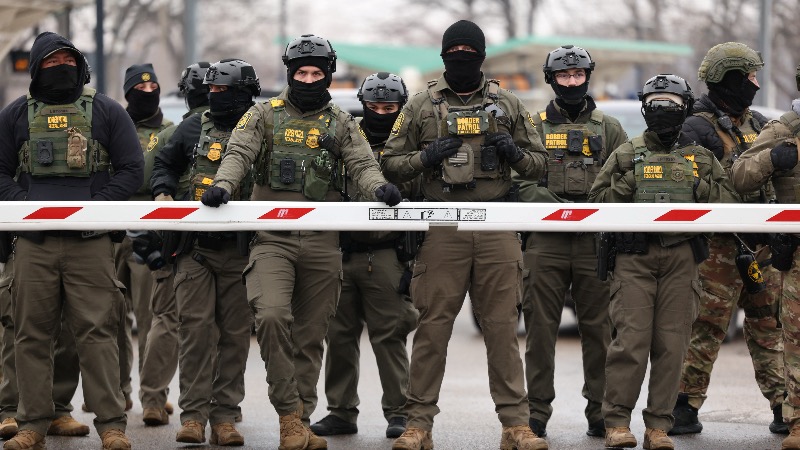
 Image Credit: CHARLY TRIBALLEAU / Contributor / Getty
A Department of Homeland Security employee allegedly leaked personal information of about 4,500 Immigration and Customs Enforcement (ICE) and Border Patrol agents to the organization ICE List.
The website hosting the leak claims to seek “accountability” from federal employees carrying out the legal constitutional duty of deporting illegal aliens. Note that “.is” in the ICE List URL is the country code for Iceland. The organization’s founder, Dominick Skinner, is Irish with American relatives, but lives in the Netherlands, according to The Daily Beast.
Skinner told The Daily Beast that an initial set of the names from the leak will be posted on Tuesday night.
“It is a sign that people aren’t happy within the U.S. government, clearly. The shooting [of Good] was the last straw for many people,” Skinner told The Daily Beast. “I’ve had hotel staff sending post-it notes, bar staff sending DHS IDs, and loads of people saying their neighbor is an agent.”
The dox list itself appears to not be live during the writing of this story. The link to it only shows “Error 503: Service has become unavailable.” Unfortunately, this is unlikely to provide relief for those affected, as one can assume the list was already copied by individuals who were seeking that data.
Following the recent leak, ICE List is now in possession of details on around 6,500 federal immigration staff.
“It [the list] appears to include names, work emails, telephone numbers, roles, and some resumé data, including previous jobs of federal immigration staff,” The Daily Beast said Tuesday.
“The ICE List is an open journalistic project, created by Crust News, aimed at collecting and sharing information that can hold ICE members legally accountable,” ICE List claimed on their homepage.
The website homepage also features a link to recruit “volunteers.” The recruitment page recommends the use of a VPN. While the page asks for a name, it also says “an alias is perfect” as well as “for your safety you should only use a secure email provider.”
The site states that the main communication channel which is used for “ICE List” operations is Signal.
“We coordinate our efforts through Signal Chat, please provide a Signal username to invite you into the relevent [sic] groups,” the recruitment page said.
Four types of “volunteer” activities are listed:
- Social media watch – Scroll social media, watch videos, take notes and screenshots.
- OSINT – Use your osint skills to find the agents online
- Outreach and Ground Work: Help us get posters out, get partners on the ground and more.
- FOIA – Use information from other teams to sumbit FOIA requests, and hopefully get information on agents.
The ICE List site also has a boycott list of companies that serve ICE agents.
“These are not only companies that have contracts with ICE, but also the stores who serve agents, hotels who host them, and any company who did not refuse service to ICE or agents of the organisation,” the site said, note the English spelling of the word “organization.”
The site, ironically, has an “ethnics” page. It is perhaps the most telling page regarding the organization’s true goals however, as few organizations require an explanation as to why they should be deemed ethical:
Naming names is not a decision we take lightly. It is an ethical obligation born out of decades of silence, impunity, and erasure. When a government agency is responsible for mass detention, deportation, and abuse, the individuals who carry out that violence must be visible. Power without visibility becomes unaccountable. That’s what the ICE List exists to challenge.
Why We Name Individuals
Every institution is made up of people. Bureaucracy shields individuals from scrutiny by dispersing responsibility across forms, departments, and procedures. But systems do not operate on their own. Every deportation involves paperwork signed by a person. Every assault inside a detention center happens under someone’s watch. Every child taken from their family passes through the hands of specific officers.
We name names to:
- Expose those who participate in systemic harm
- Challenge the myth of faceless institutions
- Break the cycle of abuse and cover-up
- Provide documentation for the public, legal teams, journalists, and families
Despite the organization’s quest to identify agents by name, it does have some restraint on releasing other personal information:
What We Don’t Do
We do not publish personal addresses, phone numbers, or information unrelated to someone’s public or institutional role. We do not target family members. We do not fabricate links or include unverified claims. We do not use this project to settle personal scores.
The method the organization uses to identify agents is described in great detail on the site’s “how we identify agents” page. A small excerpt says:
An AI research team works with us, too. They’ve developed tools that identify agents who haven’t covered their faces or changed gear. They help spot patterns in behavior, movement, and appearance that humans might miss. Their work is technical, but the results speak for themselves.
We verify agents using a layered system of confirmation: visual identification, behavioral matching, database records, and independent corroboration. Nothing makes it to the public without at least two solid confirmations. Three is preferred. It’s not just about accuracy. It’s about protection. For us, and for the truth.
Sometimes it starts with a video. An agent stepping out of an unmarked vehicle. We analyze the footage frame by frame. We look for identifiers: uniforms, badges, weapons, body language. We compare with previously known agents. If there’s a partial name badge visible, we use it. If a license plate shows up, we track it using publicly accessible databases and open-source tools.
Facial recognition helps, but it’s only one piece of the puzzle. Our volunteers are trained to spot recurring traits. We use side-by-side comparisons with verified past footage. We analyze background noise, street signs, timestamps, anything that helps establish context.
Numerous cases of Leftists threatening violence against ICE agents have been documented by Infowars – a public list of who these agents are greatly increases the risk they face.
A short list of recent examples of violent threats made to ICE agents include:
- WATCH: Top Democrats Are Openly Calling For The Killing Of ICE — Alex Jones Responds!
- Arrest Him! J6 DC Metro Cop Michael Fanone Calls For Americans To Shoot & Kill ICE, CBP Agents
- High School Assistant Principal and Brother Arrested for Plotting To Kill ICE Agents
- Video: Deranged TikTok Tranny Urges Leftists to Kill ICE Agents
- New York Man Charged for Threatening to Kill ICE Officers and Their Children
- ‘You’re Going to Start Going Home in Bodybags’: Armed Commies Threaten to Murder ICE Agents
- Shock Video: Minnesota Somali Man Threatens to Shoot Ice Agents
- Don Lemon Tells “Black & Brown” People To Buy Guns, Shoot ICE Agents
- Woman Charged for Threatening to Shoot ICE Agents
Occasionally, the threats turned to actual violence.
In July a Texas man was killed after ambushing Border Patrol agents with a rifle and tactical gear and in September an ICE facility in Dallas was shot up in a “targeted attack” that included ammunition featuring “anti-ICE” language.
“…law enforcement officers are on the frontlines arresting terrorists, gang members, murderers, pedophiles, and rapists … thanks to the malicious rhetoric of sanctuary politicians, they are under constant threat from violent agitators,” Assistant Secretary Tricia McLaughlin told the Daily Beast. “Publicizing their identities puts their lives and the lives of their families at serious risk.”
BREAKING VIDEO: Antifa Leader Calls For Leftist Militias To Attack Federal Agents!