 Image Credit: MANDEL NGAN / Contributor / Getty Images
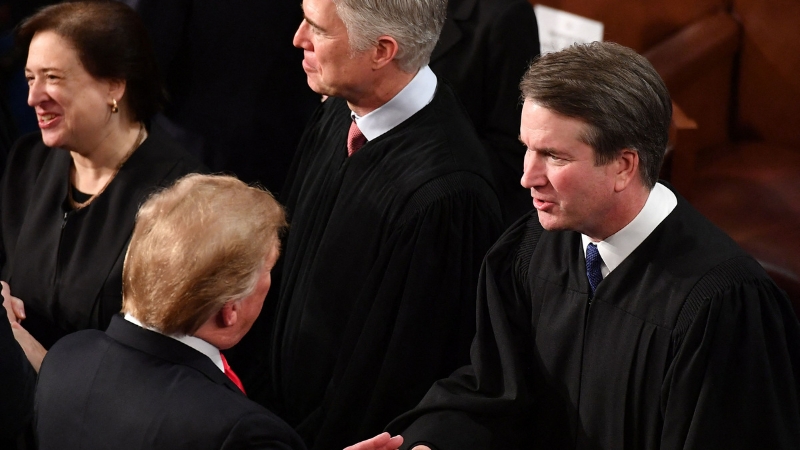
Justice Brett Kavanaugh has torched the Supreme Court’s ruling that President Trump’s flagship tariffs are illegal, warning the decision will have “serious practical consequences.”
Kavanaugh, a Trump appointee, ruled with Justices Clarence Thomas and Samuel Alito that the tariffs, issued under the International Emergency Economic Powers Act (IEEPA), are not illegal, but the remaining six judges—including Trump-appointee Amy Coney Barrett—disagreed.
In his dissent, Kavanaugh warned of “serious practical consequences in the near term” as a result of the decision.
“One issue will be refunds. Refunds of billions of dollars would have significant consequences for the U.S. Treasury. The Court says nothing today about whether, and if so how, the Government should go about returning the billions of dollars that it has collected from importers. But that process is likely to be a ‘mess,’ as was acknowledged at oral argument,” he wrote.
The US could be required to pay back billions of dollars to importers, even though they have passed on the costs to consumers.
“A second issue is the decision’s effect on the current trade deals. Because IEEPA tariffs have helped facilitate trade deals worth trillions of dollars—including with foreign nations from China to the United Kingdom to Japan, the Court’s decision could generate uncertainty regarding various trade agreements. That process, too, could be difficult.”
The case, Kavanaugh added, “presents one straightforward question of statutory interpretation: Does Congress’s explicit grant of authority in IEEPA for the President to ‘regulate… importation’ of foreign goods in declared national emergencies authorize the President to impose tariffs? The answer is a clear yes.”
Kavanaugh said there are clear precedents for Trump’s policy.
“For both the Nixon tariffs and the Ford tariffs upheld by this Court in Algonquin, the relevant statutory provisions did not specifically refer to ‘tariffs’ or ‘duties,’ but instead more broadly authorized the President to ‘regulate… importation’ or to ‘adjust the imports.’ Therefore, when IEEPA was enacted in 1977 in the wake of the Nixon and Ford tariffs and the Algonquin decision, Congress and the public plainly would have understood that the power to ‘regulate… importation’ included tariffs.”
“If Congress wanted to exclude tariffs from IEEPA, it surely would not have enacted the same broad ‘regulate… importation’ language that had just been used to justify major American tariffs on foreign imports.”
Kavanaugh went on to point out the inconsistency of the plaintiffs and Supreme Court acknowledging that the IEEPA could be used to impose quotas or even embargoes on foreign imports, but not tariffs.
“As they interpret the statute, the President could, for example, block all imports from China but cannot order even a $1 tariff on goods imported from China,” he wrote.
“That approach does not make much sense. Properly read, IEEPA does not draw such an odd distinction between quotas and embargoes on the one hand and tariffs on the other. Rather, it empowers the President to regulate imports during national emergencies with the tools Presidents have traditionally and commonly used, including quotas, embargoes, and tariffs.”
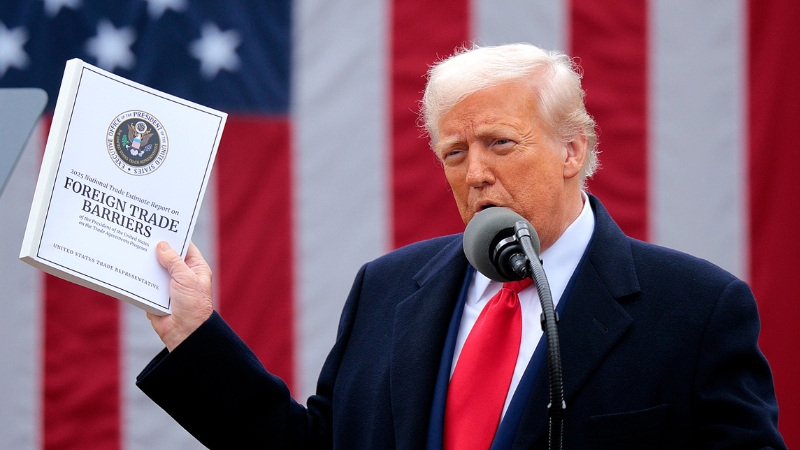
In response to the ruling, President Trump has imposed new global tariffs of 10%.
“It is my Great Honor to have just signed, from the Oval Office, a Global 10% Tariff on all Countries, which will be effective almost immediately,” Trump said on Truth Social.
The tariffs will take effect on Tuesday and will only last 150 days, unless they are extended by Congress.
The administration has indicated it is pursuing alternative ways to implement tariffs, Trump said at a briefing.
President Trump called the ruling “deeply disappointing” and said he was “ashamed” of some of the judges.
“I’m ashamed of certain members of the court—absolutely ashamed for not having the courage to do what’s right for our country.”
President Trump said there are a number of other methods available to implement tariffs, such as Sections 122, 201, and 301 of the Trade Act of 1974 and Section 338 of the Tariff Act of 1930.
“The good news is that there are methods, practices, statutes, and authorities, as recognized by the entire court in this terrible decision, and also recognized by Congress, which they refer to, that are even stronger than the IEEPA tariffs available to me as president of the United States,” Trump said.
Treasury Secretary Scott Bessent reacted to the news of the Supreme Court’s decision by saying that revenue projections will not be affected by having to issue tariffs under new authority.
“Treasury’s estimates show that the use of Section 122 authority, combined with potentially enhanced Section 232 and Section 301 tariffs, will result in virtually unchanged tariff revenue in 2026,” Bessent said.