 Image Credit: ALEX BRANDON / Contributor / Getty Images
What a difference a year makes.
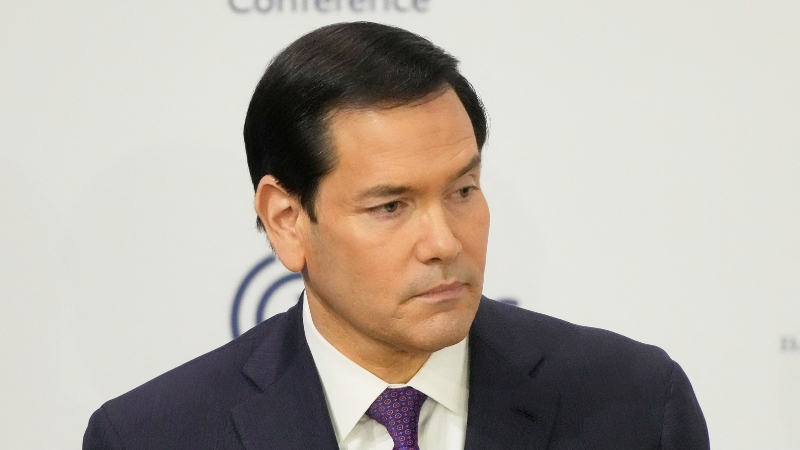
Almost 365 days after Vice President JD Vance addressed the Munich Security Conference, Secretary of State Marco Rubio returned to make his own address. While the message wasn’t all that different—Europe has strayed from its rightful path, and only a sudden and drastic change can rescue her—the tone and emphasis, and the reaction, could not have been more different.
Vance’s speech came in the early months of the second Trump presidency, while world leaders were still holding their breath to see just how big a stick of dynamite the Donald was about to lob their way.
At Munich—BANG!!!
Vance told the assembled “great and good” bluntly, without any kind of garnish, that they—not Russia or China—were the problem.
The enemy.
“The threat that I worry about most vis-a-vis Europe is not Russia,” Vance said.
“It’s not China. It’s not any external actor. What I worry about is the threat from within, the retreat of Europe from some of its most fundamental values.”
The threat from within.
Needless to say, the response was less than enthusiastic.
Here’s what I wrote at the time.
The atmosphere in the conference hall was positively funereal. At times, it seemed like the only hands being brought together in the rhythmic gesture of applause we call “clapping” were those of Vance’s own entourage. Everyone else was stock still—transfixed, horrified. The camera cut to Ursula Von der Leyen, president of the European Commission: she looked bloodless, even by her own vampiric standards—like she had just discovered a thick black hair in her steak tartare or a fly in her gazpacho.
The day after, European newspapers ran with menacing pictures of the Vice President and headlines like “Vance Lays Blame for Europe’s Plight on ‘Threat from Within’: US Vice President Sparks Fury: Democratic Values Questioned: Russian Menace Played Down.” The speech was “unacceptable,” the German defense minister was quoted as saying; a senior German diplomat branded it “totally mad… and very dangerous.”
Of course, nothing Vance said was wrong. Europe’s arrogant, complacent elites are the enemy within. They have retreated from Europe’s most fundamental values, and the longer that retreat continues, the more certain the Europe’s perdition becomes.
But, as I said at the time, nobody likes being told they’re the real problem, and they certainly don’t like being told in public, on camera.
Vance’s speech—whatever its truth—was taken as an insult. “Betrayal” was the word being banded around.
Rubio told pretty much the same story—of hubris that might, if unchecked, lead to nemesis—but he made it a shared story, one that the US, which would forever be “a child of Europe,” was also a part of. The same faults, the same myopia; but also the same solution.
The West—Europe and America—made a grave mistake by believing the end of the Soviet Union was the “End of History,” that nations and national sovereignty no longer mattered; that globalism would carry the world to a new level of prosperity and a new moral horizon, unbound by the dogmas and prejudices of the past.
But this new vision of the world was itself a dogma, and its effects have been devastating.
“In this delusion, we embraced a dogmatic vision of free and unfettered trade, even as some nations protected their economies and subsidized their companies to systematically undercut ours—shuttering our plants, resulting in large parts of our societies being de-industrialized, shipping millions of working and middle-class jobs overseas, and handing control of our critical supply chains to both adversaries and rivals,” Rubio said.
“We increasingly outsourced our sovereignty to international institutions while many nations invested in massive welfare states at the cost of maintaining the ability to defend themselves. This, even as other countries have invested in the most rapid military buildup in all of human history and have not hesitated to use hard power to pursue their own interests. To appease a climate cult, we have imposed energy policies on ourselves that are impoverishing our people, even as our competitors exploit oil and coal and natural gas and anything else—not just to power their economies, but to use as leverage against our own.
“And in a pursuit of a world without borders, we opened our doors to an unprecedented wave of mass migration that threatens the cohesion of our societies, the continuity of our culture, and the future of our people. We made these mistakes together, and now, together, we owe it to our people to face those facts and to move forward, to rebuild.”
Yes, President Trump has taken the lead in reasserting the principle of national sovereignty, of putting your own nation first above all, but this is not a zero-sum game. If Europe’s leaders do the same, we all—the West—will benefit, because we all come from the same place and have the same goals in mind, or should do.
Rubio even apologized if Americans “sometimes come off as a little direct and urgent in our counsel”—in what must have been a clear nod to Vance’s speech last year.
The US does not want “our allies to be weak, because that makes us weaker,” he added.
“We want allies who can defend themselves so that no adversary will ever be tempted to test our collective strength. This is why we do not want our allies to be shackled by guilt and shame. We want allies who are proud of their culture and of their heritage, who understand that we are heirs to the same great and noble civilization, and who, together with us, are willing and able to defend it.
“And this is why we do not want allies to rationalize the broken status quo rather than reckon with what is necessary to fix it, for we in America have no interest in being polite and orderly caretakers of the West’s managed decline. We do not seek to separate, but to revitalize an old friendship and renew the greatest civilization in human history. What we want is a reinvigorated alliance that recognizes that what has ailed our societies is not just a set of bad policies but a malaise of hopelessness and complacency. An alliance—the alliance that we want is one that is not paralyzed into inaction by fear—fear of climate change, fear of war, fear of technology. Instead, we want an alliance that boldly races into the future. And the only fear we have is the fear of the shame of not leaving our nations prouder, stronger, and wealthier for our children.
“An alliance ready to defend our people, to safeguard our interests, and to preserve the freedom of action that allows us to shape our own destiny—not one that exists to operate a global welfare state and atone for the purported sins of past generations. An alliance that does not allow its power to be outsourced, constrained, or subordinated to systems beyond its control; one that does not depend on others for the critical necessities of its national life; and one that does not maintain the polite pretense that our way of life is just one among many and that asks for permission before it acts. And above all, an alliance based on the recognition that we, the West, have inherited together—what we have inherited together is something that is unique and distinctive and irreplaceable, because this, after all, is the very foundation of the transatlantic bond.”
Rubio closed out his speech by reflecting on his own origins: on two sets of ancestors who lived in Europe, in Piedmont-Sardinia and Spain, at the time of the American founding. It was a nice little human touch. The message was clear: “both our histories and our fates will always be linked,” he concluded.
Rubio received a standing ovation for his speech.
It’s too early to say whether the speech will mark a fundamental “reset” of Euro-American relations—I suspect not, given the difficulties that still lie ahead, not least of all Russia-Ukraine—but one thing is clear: Rubio looked presidential for the first time in his career.
It’s hard not to see Rubio’s speech as a statement of intent. While JD Vance remains the favorite for the Republican nomination in 2028, Rubio has shown that he can do big diplomacy too and what’s more, maybe he can do it better. We’ll see.
Of course, talk of 2028 might seem a little premature. There’s still so much work that needs to be done before then, but I think this morning, in Munich, we got a little taste of the leadership battle to come.