 Image Credit: Majid Saeedi / Stringer / Getty
On Tuesday the IRGC (Iranian Revolutionary Guard Corp) responded to President Donald Trump’s announcement that the Iran war is “complete” by saying that Tehran will decide when the war is over, not Washington.
“I think the war is very complete, pretty much,” Trump told CBS News Monday evening. “They have no navy, no communications, they’ve got no air force … If you look, they have nothing left. There’s nothing left in a military sense.”
“It is we who will determine the end of the war,” the IRGC said in a statement Tuesday. “The equations and future status of the region are now in the hands of our armed forces; American forces will not end the war.”
Interestingly, the IRGC may not be the only foreign entity which seeks to control when the war ends.
On Sunday Trump announced that in order to put an end to the Iran war, Israeli Prime Minister Benjamin Netanyahu would have to agree to end it.
“I think it’s mutual … a little bit. We’ve been talking. I’ll make a decision at the right time, but everything’s going to be taken into account,” Trump said.
Netanyahu effectively visits President Trump every two months, much of these meetings go on behind closed doors.
“No other world leader has visited the United States in an official capacity over the past year more than Israel’s Benjamin Netanyahu,” Al Jazeera said in February. “And the Israeli prime minister is set to break his own record when he embarks on yet another trip to the U.S. this week – his sixth since President Donald Trump returned to the White House early in 2025.”
Note that while Trump did say Sunday that he will make the final decision on ending the Iran war, that decision is “mutual … a little bit.”
Controversy has swirled over the Israeli leader’s influence over the U.S. government.
On Wednesday Trump acknowledged the fact that America struck Iran to defend Israel, despite his Tuesday statement that the U.S. was in control.
Secretary of War Pete Hegseth said Tuesday that the U.S. is “winning” against the “barbarian” Iranians, adding that the Islamic Republic has been “racing” toward attaining a nuclear weapon. He explained that Washington seeks to “permanently deny Iran nuclear weapons forever.”
Hegseth did not echo the President’s feelings of completeness however, saying that “We will not relent until the enemy is totally and entirely defeated.”
After announcing how “complete” the Iran war is, Trump spoke about the Strait of Hormuz, warning Tehran not to block it:
Commercial shipping through the Strait of Hormuz, through which about 20% of the global oil supply flows, has effectively ground to a halt.
The president said the U.S. “could do a lot” about the strait and threatened Iran if it inhibits the waterway. “They’ve shot everything they have to shoot, and they better not try anything cute or it’s going to be the end of that country. … If they do anything bad, that would be the end of Iran and you’d never hear the name again.” The president also said the strait is open now and claimed ships have been entering the strait, but said he is still “thinking about taking it over.”
Alex Jones reported on Trump’s statement that the Iran war is “complete” and said the world better pray Trump is right about the war coming to an end soon before further escalation.
ZeroHedge summarized the last day of the conflict in Iran, which mostly consisted of heavy missile attacks against the Islamic Republic’s military assets:
The Pentagon’s Tuesday morning briefing really emphasized steady destruction of Iranian missile sites – even underground ballistic launch bunkers – with heavy bunker busters. However, the Islamic Revolutionary Guard Corps (IRGC) has rejected Washington claims that its missile program has been destroyed, saying it is launching larger volleys of missiles with warheads weighing more than one ton.
Iran has continued retaliatory strikes on Israel and Gulf allies, including in Bahrain, Kuwait, the United Arab Emirates, and Saudi Arabia. One person was killed in Manama and two others were killed in central Israel Monday into Tuesday.
While Israel’s military has heavily censored potential damage on the ground and the rate of Iran’s missile and drone attacks, unverified but widespread online accounts suggest it continues to get hit hard on a nightly basis.
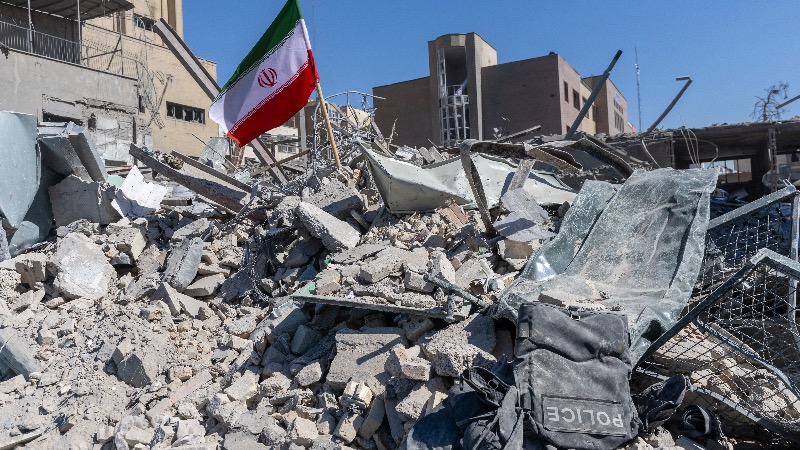
Tehran meanwhile has experienced some of the heaviest bombardment of the war overnight, with at least 40 people reported killed near Risalat Square. Since the start of the war, at least 460 people have been killed and 4,309 wounded in Tehran alone, according to the figures of Mehr Soroush, deputy head of the Tehran Emergency Health Department. The Iranian capital is densely packed with a size and population comparable to New York City.