 Image Credit: ATTA KENARE / Contributor / Getty
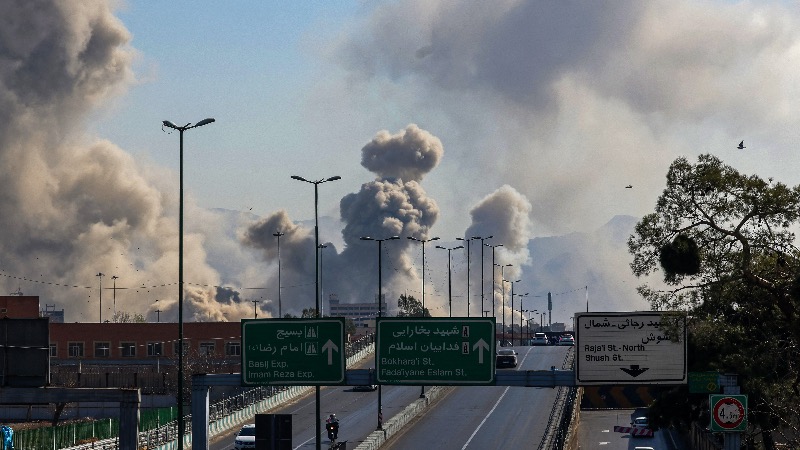
The war between Israel, the United States and Iran has rapidly reshaped the strategic landscape of the Middle East.
What began as a military operation targeting Iranian strategic infrastructure has quickly evolved into a regional conflict with direct implications for energy security, global maritime trade and Western security.
Amid this escalation, Europe is trying to walk a narrow line. No European government wants to appear as a direct party to a war against Tehran, yet neither can it afford to remain completely on the sidelines of a conflict that threatens vital trade routes, military bases and citizens deployed in the region.
The result is indirect but increasingly visible involvement: reinforcing bases, deploying naval forces, strengthening air defence, and protecting strategic maritime routes.
Officially, all European governments repeat the same formula: these are defensive operations. In practice, the continent’s military map in the Middle East shows a growing presence surrounding the conflict.
A carefully limited involvement
Since the start of the crisis, the main European capitals have stressed that the offensive campaign against Iran is being led by the United States and Israel.
Yet that line is becoming increasingly blurred. The presence of fighter jets, frigates, radar systems and missile-defence platforms in a war zone inevitably creates the risk of being drawn into the conflict if the escalation continues. For now, any escalation would likely depend on decisions taken in Washington or Jerusalem rather than in European capitals.
Europe’s strategy currently revolves around three objectives: protecting bases and military personnel deployed in the Middle East, securing key maritime routes and providing political and logistical support to Washington and its regional allies.
United Kingdom: the most involved
The United Kingdom has a visible military role, despite widespread criticism back home of the state of the country’s armed forces.
London has politically backed the actions of the United States and Israel, although the British government insists that the country “is not at war with Iran”. Prime Minister Keir Starmer’s cautious response has nevertheless drawn criticism, with some commentators arguing that the government reacted too slowly as the conflict escalated. U.S. President Donald Trump has also criticised the British government for what he described as a hesitant response to the crisis.
Nonetheless, there has been some British military deployment in the region. The Royal Air Force has deployed Typhoon fighter jets and support aircraft to bases in Cyprus and Qatar, ready for air-defence and surveillance missions.
From RAF Akrotiri in Cyprus, reconnaissance operations, airspace control and the protection of regional allies are coordinated. The base has also become a focal point of the crisis after Iranian drone attacks targeted British facilities there.
The Royal Navy maintains a presence in the region, supported by British facilities in Bahrain and Oman that serve as logistical hubs for naval operations. However, the limited number of operational British warships has also become a subject of debate in London, highlighting the constraints on the country’s ability to project naval power during the crisis.
London retains significant operational capabilities, though its military presence in the region is smaller than in previous decades.
France: structural military presence
France possesses one of Europe’s most extensive military networks in the Middle East, which inevitably makes Paris one of the most relevant European actors in the regional landscape.
The French government has stressed from the beginning of the crisis that it has not participated in attacks on Iran and that its posture is strictly defensive. Nevertheless, the reinforcement of the French military deployment shows how seriously Paris is preparing for a possible deterioration of the situation.
France operates from Al Dhafra Air Base in the United Arab Emirates, from which fighter jets and support aircraft are based. This has been complemented by additional air reinforcements—including Rafale fighter jets—and the deployment of warships in the Gulf and the Eastern Mediterranean. The aircraft carrier Charles de Gaulle has also been mobilised to reinforce the French presence in the region.
In addition, the French base in Djibouti provides Paris with a strategic platform to project naval power towards the Red Sea and the Bab el-Mandeb Strait, another critical chokepoint for global trade.
Germany and Europe’s defensive support
Germany has opted for a more limited involvement, consistent with its traditional military caution since the end of the Second World War. Berlin politically supports its Western allies and has backed joint statements describing defensive measures against Iranian attacks as “necessary and proportionate.”
However, the German government has made clear that it will not participate in offensive operations. Its contribution focuses on defensive tasks: protecting personnel deployed in the region, providing logistical support and participating in maritime security initiatives.
Within this framework, Germany takes part in the European naval mission ASPIDES, created to protect merchant traffic in the Red Sea from drone and missile attacks.
Other European allies
Other European countries participate to a lesser extent, generally within multinational frameworksor coordinated naval missions.
Spain has deployed its most advanced frigate (Cristóbal Colón) to support the British base in Cyprus despite recent international controversy surrounding the supposed opposition of the socialist government—an opposition that ultimately did not materialise.
Italy plays a prominent role by leading the European ASPIDES mission and deploying destroyers and frigates tasked with escorting commercial vessels in the Red Sea. The Netherlands, Denmark, Greece and Belgium contribute ships, military personnel or staff officers within these maritime security structures.
This arrangement allows many European governments to share responsibilities without appearing directly on the front line of the conflict. However, it also means that a sudden escalation could involve several countries simultaneously.
Maritime routes as the strategic front
Beyond bases and air deployments, the main arena of European presence lies at sea. The security of trade routes is a central concern for European economies, which remain deeply dependent on maritime traffic.
The Red Sea and the Bab el-Mandeb Strait concentrate much of Europe’s naval activity. The ASPIDES mission operates there, escorting merchant vessels and monitoring potential attacks against international shipping.
Further east, the Strait of Hormuz represents another critical chokepoint whenever tensions escalate. About one quarter of the world’s seaborne oil passes through this corridor. British and French frigates and destroyers regularly patrol these waters to guarantee freedom of navigation.
The Eastern Mediterranean, meanwhile, functions as an operational rear base. Bases in Cyprus, French naval deployments and aerial surveillance platforms allow Western allies to monitor Syria, Iraq and parts of western Iran without entering Iranian airspace directly.
European bases under threat
Europe’s growing military presence has not gone unnoticed in Tehran. Iranian authorities have explicitly warned that any country participating in offensive operations against Iran will be considered part of the conflict.
This places several European installations within the potential range of Iranian retaliation. Among the most significant are the British base at RAF Akrotiri in Cyprus, British naval facilities in Bahrain and various French positions in the United Arab Emirates.
Some European-linked facilities have already come under attack—most notably the drone strike on the UK base at RAF Akrotiri—while other strikes have landed close to Western and allied installations in the Gulf.
For now, Europe is trying to remain in the background. But the longer the conflict lasts, the harder it will be to maintain that position.
IT’S OFFICIAL: The US Has Now Invaded Iran & Says The War Will Go Until September!