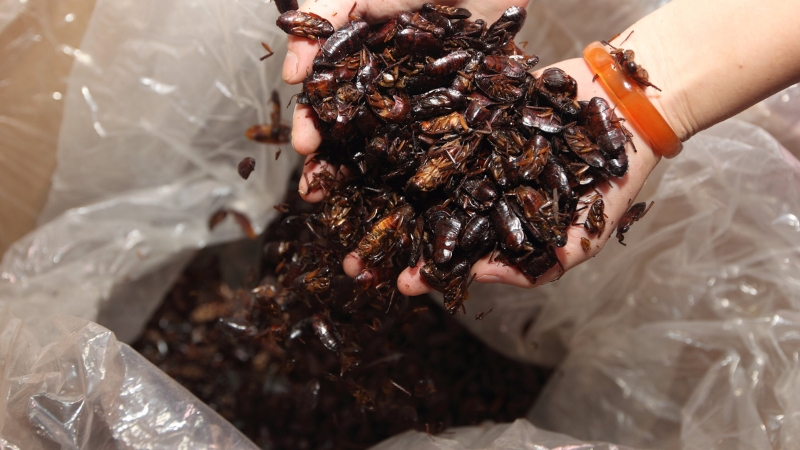
 Image Credit: Southern Metropolis Daily / Contributor / Getty Images
When I read the global insect-farming industry is collapsing, my first thought was—USAID! Of course!
Perhaps the greatest revelation of the Department of Government Efficiency, apart from the sheer, staggering scale of the pork, was just how much of it was being funnelled through USAID—and, of course, where it was going and to whom.
All of a sudden, we discovered that literally everything awful in the world—from drag-queen storytime in Vanu’atu and sex-changes for dwarfs in Morocco, to research into rare aardvark viruses and cat-torture in China—all of it was being paid for with US taxpayer money via USAID.
Fancy that!?
So why not insect-farming too?
It certainly fits the bill. It’s evil and disgusting and runs counter to all our deepest, most fundamental instincts; it serves no real purpose except to degrade, humiliate and elicit sniggers—if not uproarious laughter—from those who came up with the idea and would never, under any circumstances, do it themselves.
In short, it’s perfect.
Well, I did a little digging and, to my surprise, it doesn’t look like the US taxpayer was propping up the global insect-farming industry, not really. USAID made a “request for information” in 2022, meaning it was looking for input on how it could invest in the industry, but other than that it was just a few small-scale projects in places like Uganda, Madagascar and Indonesia to help farmers feed their livestock with black soldier flies or dispose of waste by feeding it to worms—stuff like that.
So, it’s just a coincidence that insect-farming is on its last… legs, ahem, after Kekius Maximus took his gold-plated chainsaw to the United States Agency for International Development.
Anyway, none of this changes the fact that insect-farmers are, indeed, in very deep trouble.
A long article on Mother Jones examines the industry’s woes in detail, from its early days with so much promise, when billions of dollars poured into startups from venture-capital firms and governments; to today’s dismal prospects. In recent years, almost a quarter of the 20 largest insect-farming startups have now failed, including the biggest, Ynsect, which came tumbling down last December.
“Things have gone from bad to worse for the big insect factory business model,” one unhappy CEO said in a YouTube video.
Plans for further expansion, including the building of a massive insect farm in Nebraska by Tyson Foods, have been placed on indefinite hold.
As if to add insult to injury, moral philosophers are now proposing that, far from being ethical, bug-farming on an industrial scale is, like traditional farming, deeply immoral. Insects, apparently, have some form of consciousness, feel pain and may even have opinions about the final season of Stranger Things.
I pondered the question of insect sentience this morning while I sat on the toilet and watched a woodlouse meander across the bathroom floor. Frankly, I’m not convinced. But if moral philosophers—a useless lot, for the most part—can make life harder for insect-farmers, then I’m happy to let them do it.
End cruelty to mealworms! Worker ants of the world, unite—you have nothing to lose but your chains!
Energy-price increases have played a big role in the industry’s misery, driving up the cost of heating the enormous warehouses where the insects are farmed. Costs are especially high in Europe, where more sensible energy policies could have been devised by a four-year-old child with water on the brain.
It also turns out feeding insects is expensive—maybe even more expensive than feeding some larger animals, like fish. We were told the opposite.
But, of course, the biggest problem is that nobody wants to eat insects. Obviously. It doesn’t matter how many times we’re told “cockroach milk” is the next superfood, or that we have to eat crickets instead of chicken to save the planet from global boiling, people just don’t want to do it.
In large part, the problems of the insect-farmers are the problems of the so-called “alternative protein” industry more broadly.
Nobody wants to eat “plant-based meat” either, or “plant-based eggs,” or “lab-grown meat” or any other eldritch abomination spawned in a bioreactor and dressed up as a cruel mockery of Mother Nature’s perfection.
During the pandemic, the makers of these products started to change tack as it became clear sales were flagging and projections laughably optimistic. They turned from claims about taste and health benefits—which nobody really believed—to manipulation and shame-based marketing. The most notable example was the barf-inducing “Help Dad” campaign from “oat-milk” brand Oatly. Tragically unhip fathers were confronted by their broccoli-haired kids and put through a plant-based struggle-session at the fridge door. Dad’s crime? Reaching for a cold glass of cow’s milk instead of Oatly.
Unsurprisingly, despite market research that suggests shame is the best way to market oat milk and insects, consumers aren’t buying it. So long as there are free-market mechanisms driving what ends up on store shelves, consumers will keep on buying the real thing instead.
Which is why pressure groups are now trying to get government to step in and force consumers to buy insects. The International Platform of Insects for Food and Feed is calling on the European Union to mandate that taxpayer-funded food services, including school cafeterias, sell insect “meat” and that publicly owned farms feed their animals insectmeal—ground-up insects. Other groups are trying to do the same thing in the US.
Good luck with that.