 Image Credit: ATTA KENARE / Contributor / Getty
A think tank analysis document from 2009 outlined how the U.S. or Israel could launch a regime change war on Iran under the guise of negotiations – using the cover of failed diplomacy to curry public favor for an otherwise unpopular conflict.
The analysis white paper “Which Path To Persia? Options for a New American Strategy toward Iran” published by The Saban Center for Middle East Policy at The Brookings Institute outlined a war plan which would begin with peaceful talks that are intended to fail, the failure of which could be pointed to as the reason for an offensive military operation.
“The best way to minimize international opprobrium and maximize support (however, grudging or covert) is to strike only when there is a widespread conviction that the Iranians were given but then rejected a superb offer—one so good that only a regime determined to acquire nuclear weapons and acquire them for the wrong reasons would turn it down,” the document said on page 39. “Under those circumstances, the United States (or Israel) could portray its operations as taken in sorrow, not anger, and at least some in the international community would conclude that the Iranians ‘brought it on themselves’ by refusing a very good deal.”
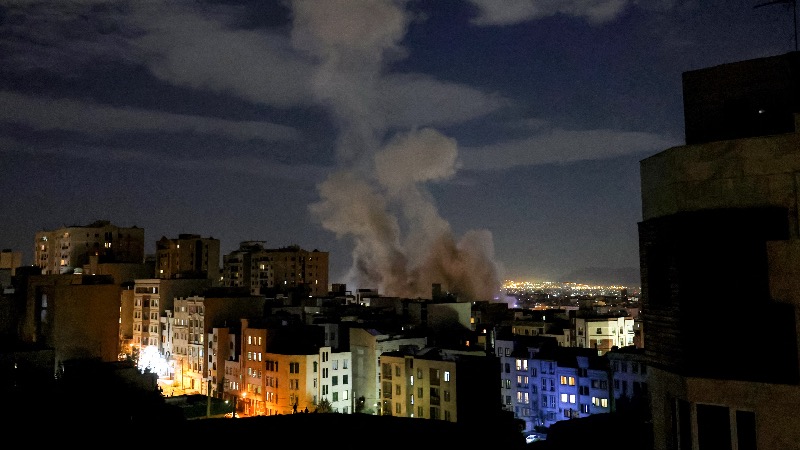
Embed from Getty ImagesImage credit: TEHRAN, IRAN – MARCH 2: Men watch from a hillside as a plume of smoke rises after an explosion on March 2, 2026 in Tehran, Iran. The United States and Israel continued their joint attacks that erupted on February 28. Iran retaliated by firing waves of missiles and drones at Israel, and targeting U.S. allies in the region. (Photo by Majid Saeedi/Getty Images)
Recent negotiations running cover for a pre-planned attack appear likely, as Reuters reported on Saturday that “An Israeli defense official said the operation had been planned for months in coordination with Washington, and that the launch date was decided weeks ago.”
Embed from Getty ImagesImage credit: TOPSHOT – A fireball lights the sky following a missile strike on Tel Aviv on February 28, 2026. The United States and Israel launched strikes against Iran on February 28, with Israel’s public broadcaster reporting that the Iranian supreme leader had been targeted, as the Islamic republic retaliated with barrages of missiles at Gulf states and Israel. (Photo by JOHN WESSELS / AFP via Getty Images)
The Cradle gave a rundown on events leading up to the strike:
Amid the negotiations, Trump sent an “armada” of U.S. naval ships and warplanes to the region, threatening to launch an attack if officials in Tehran refused to make a deal.
After the latest round of talks on Thursday, a senior U.S. official told Axios the talks were “positive.”
Omani Foreign Minister Badr Albusaidi, who mediated the talks, said the talks had shown “significant progress.”
Iranian Foreign Minister Abbas Araghchi also expressed optimism, saying both sides had shown a “clear seriousness” about getting a deal.
However, the U.S. and Israel launched large-scale attacks against Iranian targets early Saturday, suggesting the negotiations had never been serious.
AF Post reported that Israel had already decided to strike Iran, and that the U.S. decided to join in on the attack:
Page 65 of the white paper detailed how the U.S. could wait for Iran to provoke a military action against it before attacking Iran, but cautioned that if the public realizes they’re being misled into a war the mystique of the propaganda would quickly fade.
“…if the United States were to decide that to garner greater international support, galvanize U.S. domestic support, and/or provide a legal justification for an invasion, it would be best to wait for an Iranian provocation,” page 65 said. “And it is certainly the case that if Washington sought such a provocation, it could take actions that might make it more likely that Tehran would do so (although being too obvious about this could nullify the provocation).”
Page 66 explained that short of a 9/11-style scenario to blame on Iran, invasion will be incredibly hard to sell to the American public and the international community.
“Most European, Asian, and Middle Eastern publics are dead set against any American military action against Iran derived from the current differences between Iran and the international community—let alone Iran and the United States. Other than a Tehran-sponsored 9/11, it is hard to imagine what would change their minds,” page 66 said.
The document began by mentioning Iran’s strong anti-U.S. sentiment while also being home to a large percentage of citizens who harbor favorable opinions of the U.S. and the West. The authors detail the political history of Iran since the 1979 Islamic Revolution to give context to the discussion.
The analysis focused on Iran’s position on the geopolitical grand chessboard following the Middle Eastern conflicts of the early 21st century, with Tehran’s nuclear ambitions increasing the importance of action. Page 1 of the document states “the 2007 National Intelligence Estimate on Iran, properly understood, warned that Tehran was likely to acquire the capability to manufacture nuclear weapons at some point in the next decade.”
Page 2 detailed the George W. Bush administration’s “weak hand” policy of diplomatic pressure toward Iran, then posits that Barack Obama’s administration should take a “more ambitious” approach to the Islamic Republic.
The analysis has four main parts, Dissuading Tehran: The Diplomatic Options, Disarming Tehran: The Military Options, Toppling Tehran: Regime Change and Deterring Tehran: Containment.
Four main categories of Iranian threats to the U.S. are listed: support for violent extremist groups, efforts to subvert U.S. allies, efforts to block an Arab-Israeli peace agreement and development of weapons of mass destruction.
Page 18 said that the Obama administration is facing a “ticking clock” of Iran being able to develop a nuclear weapon, which it predicted would happen some time around 2010 to 2015.
Obama ended up making a nuclear deal with Tehran in 2015. That deal involved Washington shipping $400 million in cash on pallets to Tehran in exchange for the promise they will refrain from developing nuclear weapons. President Donald Trump was unhappy with the 2015 Iran nuclear deal and withdrew from it during his first term in office.
During the first year of his second term in office, Trump appeared to be optimistic of reaching a nuclear deal with Tehran, his officials holding regular negotiations with Iranian officials up until the day the U.S. and Israel launched a massive military operation against the Islamic Republic.
Page 21 of the white paper outlined methods of dissuading Tehran from pursuing nuclear weapons through diplomatic options. Persuasion tactics were discussed on page 23, which described “an offer Iran shouldn’t refuse.”
The persuasion policy’s goal is said to be to change Tehran’s mind on issues critical to Washington, not regime change.
“The core concept of the Persuasion approach remains the idea of simultaneously offering Iran a series of compelling rewards for giving up its nuclear program (and possibly ceasing its other deleterious behavior as well) and threatening to impose harsh penalties on Iran for refusing to do so. In essence, it means offering Iran a ‘deal,’ but one that also contains an implicit ultimatum: change your ways and you will be rewarded; don’t and you will be punished,” page 26 said.
Page 27 goes over how Iran would be more willing to accept a deal that allows it to utilize nuclear energy, just not build nuclear weapons. It also mentions how other international parties (European countries) are against Iran maintaining any nuclear technology.
Throughout negotiations between Washington and Tehran in 2025 and 2026, the Islamic Republic denied any interest in nuclear weapon development, but fiercely maintained its interest in developing peaceful nuclear technology. Israeli Prime Minister Benjamin Netanyahu said he would only accept a deal that prohibits all nuclear technology in Iran, including nuclear energy.
Page 28 through 30 discuss the likely fear Tehran has that not possessing nuclear weapons keeps it open to foreign attacks, and how security guarantees from the U.S. could lessen that concern.
Page 31 through 34 describe how to “bring the hammer down” on Iran through sanctions if it fails to make a deal.
Page 42 begins the section on the engagement option of “tempting Iran.” That strategy is based on the belief that punishing Iran through sanctions could embolden it in its quest to attain nuclear weapons. The strategy seeks to “drop the sticks and instead focus on the carrots as the only way of creating a set of incentives that the Iranian regime might accept.”
Page 61 describes the military option of disarming Iran. The aforementioned diplomatic options require Tehran to comply, but the military option could succeed in disarming Iran when the others fail. The downside to this option is public opposition to war in the U.S. – hence the ability to sell the war on the false pretense of failed negotiations.
Fascinatingly, Trump’s airstrike against Iran’s nuclear facilities in June 2025 coincides with a sentence on page 62, “Airstrikes against Iran’s nuclear facilities are the most frequently discussed military option for the United States and Israel, and indeed they are the most likely scenario for the use of force.”
Page 63 discussed “going all the way” with an invasion of Iran. The document explained how this would be immensely unpopular with the American public as well as difficult for the overstretched U.S. military. The task would not be quick either.
“Consequently, if the United States ever were to contemplate an invasion of Iran, it would likely find itself in the same bind as it is in Iraq: the country is too important to be allowed to slide into chaos, but given Iran’s internal divisions and dysfunctional governmental system, it would be a major undertaking to rebuild it. As with Iraq and Afghanistan, the reconstruction of Iran would likely be the longest and hardest part of any invasion, and would generate risks and costs so great that a decision to invade could only be responsibly made if there were a concomitant commitment to a full-scale effort to ensure the country’s stability afterwards,” page 64 said.
As previously mentioned, page 66 explained that the only scenario that could likely be used to codify public support behind an invasion of Iran would be a 9/11-style attack, which the document said is unlikely to happen.
“…there does not seem to be much utility in examining an American invasion of Iran in the context of an overt Iranian attack that produced mass American civilian casualties. It does not seem to be a scenario that the United States is likely to face, nor is it an ‘option’ for American foreign policy because the outcry from the American people for an overwhelming military response would drown out all other possible approaches,” pages 67 said.
Page 67 described how Israel would be the main country in support of a U.S. attack on Iran, “To be blunt, Israel is probably the only country that would publicly support an American invasion of Iran, and because of its difficult circumstances, it would not be in a position to furnish much assistance of any kind to the United States.”
Page 73 explained how an invasion of Iran would likely destroy America’s reputation on the world stage and hinder its soft power abilities.
Page 74 began the section on the “The Osiraq Option” of airstrikes, “such a policy would most likely target Iran’s various nuclear facilities (possibly including key weapons delivery systems such as ballistic missiles).” Page 79 detailed likely targets for these strikes, including locations Trump struck in 2025 (Esfahan and Natanz).
Page 82 detailed how Iran is likely to retaliate to a U.S. air campaign against it, from returning fire to terror attacks. Page 83 goes over why airstrikes are likely not a stand-alone option.
“If the United States were to adopt the Airstrikes option, it would have to anticipate that the initial round of airstrikes would not eliminate the problem altogether, and so the policy would have to include a series of next steps to cover the long term. As already noted, some proponents of the Airstrikes option argue that the right long-term approach is simply repeated airstrikes: every time the Iranians begin to rebuild their nuclear program, strike again to knock it down. They argue that, if nothing else, this would simply keep pushing the operational date of an Iranian nuclear weapon farther and farther into the future. At best, repeated airstrikes might eventually convince the Iranian people that their leaders’ policies were bringing ruin on their country, and so they would overthrow the regime,” page 83 said.
Page 89 began the chapter “Leave It To Bibi” – allowing or encouraging an Israeli military strike.
“In short, there is considerable reason to believe that under the right (or wrong) set of circumstances, Israel would launch an attack—principally airstrikes, but possibly backed by special forces operations—to destroy Iran’s nuclear program,” page 90 said.
Page 101 explained the option of toppling Iran with regime change, “There are several ways in which the United States could change the regime or undermine it: supporting a popular revolution, stirring up Iran’s ethnic groups, or promoting a coup.” The next few chapters describe each of those methods as well as their benefits and drawbacks.
The final section, beginning on page 129, detailed how to contain Iran with deterrence, which has been the U.S. policy since the Islamic Revolution. On page 131 the document went over why that option is now unacceptable – Iran’s quest for nuclear weapons.
The conclusion section began on page 145 by explaining how all possible policy tactics toward Iran have downsides and require contingency plans and “because the problem of Iran is such a difficult one, any realistic policy toward Iran likely would combine at least two or more options, either in sequence, as contingency plans, or as parallel tracks. A single option approach to the problem of Iran would have much less likelihood of achieving U.S. interests.”
Page iii of the document contained the disclaimer, “None of the ideas expressed in this volume should be construed as representing the views of any of the individual authors. The collection is a collaborative effort, and the authors attempted to present each of the options as objectively as possible, without introducing their own subjective opinions about them. The aim of this exercise was to highlight the challenges of all the options and to allow readers to decide for themselves which they believe to be best. All statements of fact, opinion, or analysis expressed are those of the authors and do not reflect the official positions or views of the CIA or any other U.S. Government Agency. Nothing in the contents should be construed as asserting or implying U.S. Government authentication of information or Agency endorsement of the authors’ views. This material has been reviewed by the CIA to prevent the disclosure of classified information.”