 Image Credit: Anadolu / Contributor / Getty
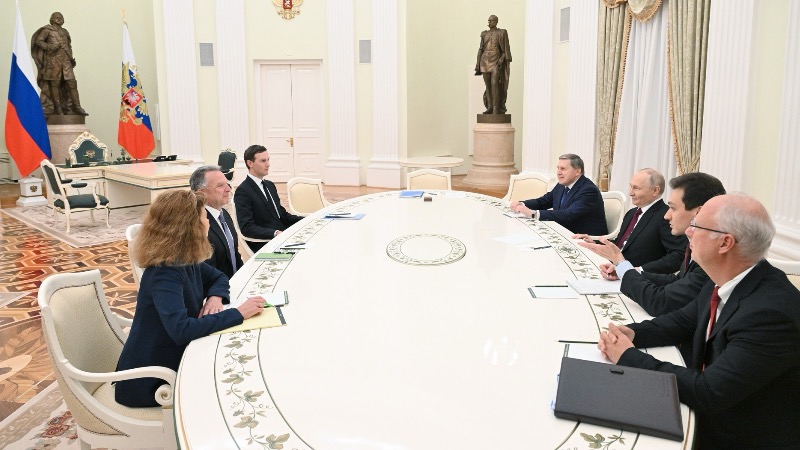
On Tuesday President Donald Trump’s Special Envoy Steve Witkoff and Trump’s son-in-law Jared Kushner met with Russian President Vladimir Putin and his aides Yury Ushakov and Kirill Dmitriev to discuss an ongoing attempt at a peace plan for the Ukraine war. The original peace proposal was a 28-point plan that European leaders picked apart until it was unacceptable to Russia. After Sunday’s discussions between officials from Washington and Kiev, it is now Moscow’s turn at the negotiations.
One of the major points of contention are territorial disputes – Kiev and its European enablers refuse to cede any land to Russia while Moscow refuses to end the war if they cannot maintain possession of some eastern Ukrainian territories. This issue was not resolved in Tuesday’s negotiations, bringing the two warring nations no closer to peace.
The officials from Washington presented the Russians with four more documents concerning the peace settlement, likely documents that stem from the meeting with officials from Kiev on Sunday.
Another point of contention are security guarantees – Kiev and Europe want Ukraine to join NATO while Moscow refuses to accept a NATO membership for Ukraine as part of ending the war.
“Some American proposals are acceptable to Russia, while others are not,” Ushakov said of the negotiations as a whole.
While Tuesday’s meeting, which went for about five hours, was characterized as constructive and substantial, it yielded no results in ending the war.
“We discussed the substance, not specific wording and solutions. The parties see enormous potential for cooperation,” Ushakov said.
The developments from Tuesday’s meeting were not enough to warrant another meeting between Trump and Putin at this time.
“A possible meeting at the presidential level will depend on how much progress we can make along this line,” Ushakov told journalists. “We will continue [talks] at the level of representatives and assistants.”
Dmitriev described the meeting as “productive.”
“Our people are over in Russia right now to see if we can get it settled. Not an easy situation, let me tell you. What a mess,” President Donald Trump said at a cabinet meeting in Washington.
🇺🇸🇷🇺🇺🇦 The US is no longer financially involved in the war between Ukraine and Russia, — Trump
— The Daily News (@DailyNewsJustIn) December 2, 2025
US representatives in Russia are working to determine whether a Ukrainian settlement is possible, we hope for a resolution of the conflict.
The states are no longer financially… pic.twitter.com/D292Dj8d05
Ukraine’s Dictator Vladimir Zelensky issued an interesting statement which said that it will not be easy to end his war, but that he is in control and will be the one making the decisions:
There will be no simple solutions to ending the war. We understand what is happening. We understand who we are dealing with. The issue is not the complexity of making decisions. I am capable of making them. It is important that everything be fair and transparent. So that there is no game behind Ukraine’s back. So that nothing is decided without Ukraine about us, about our future.
The most sensitive issues and the most difficult questions concern territories, frozen assets. I cannot speak on behalf of European leaders about the frozen funds in Europe. I can only share my vision, and they can support me. And about security guarantees. We are counting on strong security guarantees from the United States and Europe, as well as some other leaders. This is one of the topics of the Willing Coalition. We are working on it. I think that these three topics are the most sensitive and the most important. Our teams will continue to work on them.
Preceding the meeting Tuesday Putin warned that Russia is prepared for an all-out war with Europe, however starting a massive war is not Moscow’s intention.
“We are not planning to go to war with Europe, but if Europe wants to and starts, we are ready right now,” Putin said.
Putin also said officials in Kiev are acting as if they live on “another planet,” due to being unaware of Ukraine’s economic situation and its position on the front line.
“Constantly being on the road while going around begging for money, he [Zelensky] probably has no time for day-to-day issues in the economy, and even less so at the front,” Putin told reporters, likely referencing Zelensky’s visit to Ireland where he fleeced the government for $125 million euros Tuesday.
RT detailed the current battlefield situation which is getting evermore grim for Ukraine:
At a briefing on Sunday, the chief of Russia’s General Staff, Valery Gerasimov, told President Putin that the military has taken control of several key frontline cities, including Krasnoarmeysk (Pokrovsk) in Russia’s Donbass and Volchansk in Ukraine’s Kharkov Region.
The reality of the frontline situation – coupled with manpower shortages and ongoing mobilization problems – may pile even more pressure on the beleaguered Zelensky to finally make a deal.
The EU had plans to use frozen Russian assets to fund the war against Russia with. That plan has gotten pushback from the U.S. according to a report in Politico:
U.S. OBJECTED TO EU’S FROZEN ASSETS PLAN: By now, Belgium’s objections to using a pot of €170 billion in immobilized Russian assets are well-known. But Belgian Prime Minister Bart De Wever may have some powerful allies in his refusal to go along with the “reparation loan” — Donald Trump’s administration.
Scoop: When EU sanctions envoy David O’Sullivan traveled to Washington during the summer, U.S. officials told him in no uncertain terms that their plan was to return the assets to Russia after the signing of any peace plan, according to two senior diplomats who spoke to Playbook and Gregorio.
The U.S. Department of War has now suspended a contact with Germany’s Defense Ministry that regarded arms shipments to Ukraine.
German Lt. General Christian Freuding complained to The Atlantic about how the U.S. is no longer doing everything Berlin wants it to do, and cited a German political party from 80-years ago to try and curry favor and build credibility:
Freuding had once been able to text American defense officials “day and night,” he said, but lately communication with his counterparts in Washington had been “cut off, really cut off.” The Trump administration had offered no warning, for instance, about its move to suspend certain weapons shipments to Ukraine.
Some Ukrainian officials don’t hold the “their way or the highway” mindset, former Ukrainian Foreign Minister Dmitry Kuleba said that in order to end the war they must accept an “agreement that no one will like.”
“We are in a situation where Russia has the ability to destroy us, and we are not strong enough to fully protect ourselves,” Kuleba said at a conference in Kiev on Monday, going on to explain that only a deal “that no one will like” which locks in a “tactical defeat and strategic victory” could prevent “many more years of war… even worse.”