 Image Credit: @ItIsHoeMath / X screenshot
On Friday President Donald Trump announced that he is reseting the corporate average fuel economy (CAFE) standards which have made small gasoline and diesel-powered cars nearly impossible to manufacture in great numbers due to the segment’s stringent fuel economy requirements. This regulation has in part driven up the popularity of obese-looking vehicles and pickup trucks for those who never haul anything beside their man purse in the bed, due to larger vehicles being held to a more lenient fuel mileage standard.
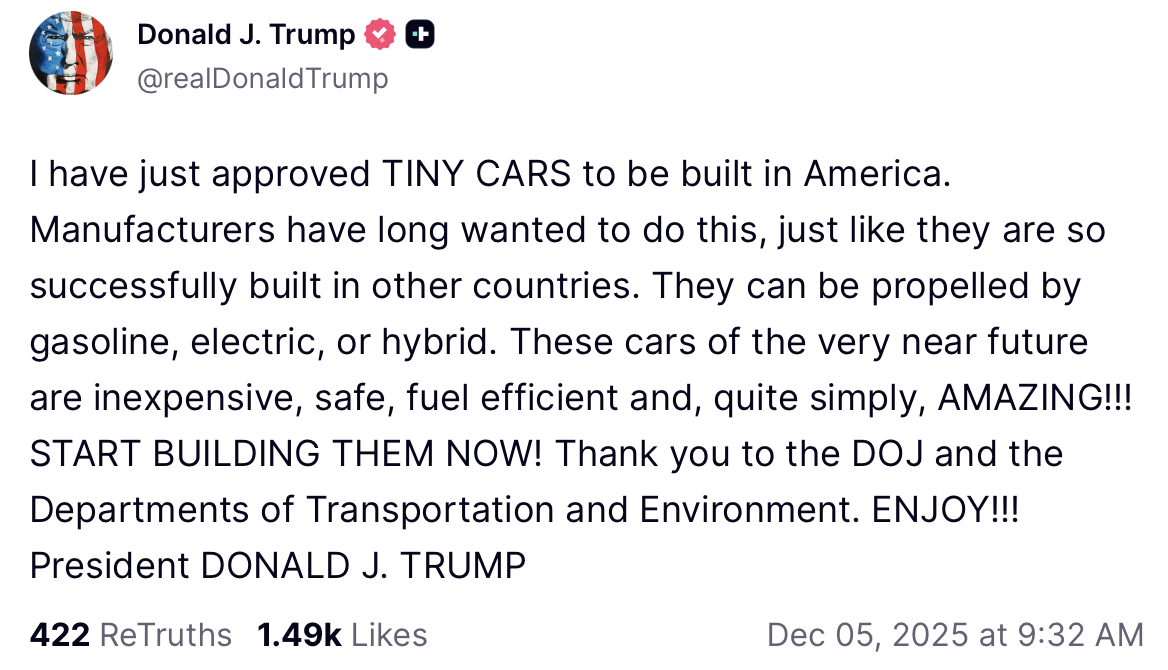
I have just approved TINY CARS to be built in America. Manufacturers have long wanted to do this, just like they are so successfully built in other countries. They can be propelled by gasoline, electric, or hybrid. These cars of the very near future are inexpensive, safe, fuel efficient and, quite simply, AMAZING!!! START BUILDING THEM NOW! Thank you to the DOJ and the Departments of Transportation and Environment. ENJOY!!! President DONALD J. TRUMP
The White House issued a press release which detailed the scaling back of these restrictions. While the White House detailed how this regulation reduction will kill the (effective) battery-powered vehicle mandate and save Americans the costs associated with it, it only repeals the onerous Biden-era restrictions (average fuel economy of 50.4 miles a gallon by 2031) but not prior CAFE standard requirements that have also contributed to the plumping of the automobile.
The White House press release said:
DELIVERING A WIN FOR AMERICAN FAMILIES AND AUTOMAKERS: Today, President Donald J. Trump is delivering major relief to American families by resetting the Biden Administration’s costly and unlawful Corporate Average Fuel Economy (CAFE) standards.
- President Trump is returning CAFE standards to levels that can actually be met with conventional gasoline and diesel vehicles. The Biden Administration standards imposed unrealistic fuel economy targets that effectively resulted in an electric vehicle (EV) mandate.
- The Trump Administration’s reset of the CAFE standards ensures the program’s fidelity to the legal restrictions set forth by Congress.
- The Biden standards broke the law by going far beyond the requirements that were mandated by Congress when it created the CAFE program.
A Department of Transportation press release went further into detail, stating:
Consistent with direction in Secretary Duffy’s memorandum, “Fixing the CAFE Program,” NHTSA is proposing to reset CAFE standards for model years 2022-2031. From those reset standards, developed without consideration of electric vehicles and credit trading, NHTSA is proposing to increase the fuel economy standard by 0.5% per year for passenger cars from model years 2023 through 2026, followed by 0.35% in model year 2027, and 0.25% from model year 2029 to 2031. For light trucks, NHTSA is proposing an increase of 0.5% for model year 2023 through 2026, followed by 0.7% in model year 2027, and 0.25% from model year 2029 to 2031.
In terms of miles per gallon, NHTSA estimates that the proposed standards would achieve a fleet average fuel economy of 34.5 miles per gallon by model year 2031. The proposed standards would also eliminate the CAFE credit trading program starting in model year 2028, which artificially propped up the EV industry at the expense of traditional automakers. And, the proposed rule would reclassify crossovers and small SUVs as passenger automobiles instead of light trucks, removing a market distortion that existed for decades and realigning the categories with congressional intent.
While the CAFE standards have been around for decades, their requirements have been tightened numerous times, causing manufacturers to prioritize the sale of massive vehicles to those who don’t benefit from them.
While not meeting these standards is not outright prohibited, failure of an automaker to meet these requirements results in a fine, driving up the price of their vehicles and thus the prohibitive nature of selling small, financially economical cars to those whose personal transport is on a budget. When a person can’t afford a car of their own, they are relegated to public transit with the undesirables who occasionally set fire to fellow passengers and slit their throats.
“Congress first established Corporate Average Fuel Economy (CAFE) standards in 1975, largely in response to the 1973 oil embargo. CAFE standards set the average new vehicle fuel economy, as weighted by sales, that a manufacturer’s fleet must achieve,” The Union of Concerned Scientists said.
From the opposite end, meeting CAFE standards also drives up the propensity of manufacturers to produce engines which prioritize economy over reliability.
These modern engines often utilize direct injection, forced induction, wet belt timing systems, higher operating temperatures, and are rated for low viscosity oil, all technologies that decrease reliability and longevity.
These restrictions have not just driven up the popularity of larger vehicles, they have also effectively killed off the mini pickup trucks.
It should be noted that CAFE standards are not the only factor driving up the size of cars. People themselves are getting larger. Over half of Americans are now obese, so the need for obese vehicles that can comfortably carry them has also increased.
Ever-stricter safety regulations have also driven up the size of cars. But unlike the need for obese cars for obese people, government safety regulations are outright hypocritical as they originate from the same government that promoted the lethal Covid injection, murdered nearly 3,000 of its own people on 9/11, waged forever wars, and still to this day allows people to ride motorcycles – a method of transport far more deadly than any unsafe car.
JD Power detailed the extreme danger of motorcycles, stating that when riding the two-wheeled death machines:
- The chances of a fatality in a motorcycle accident are approximately 30 times higher than in a car.
- Motorcycle accidents have a staggering 80% injury or death rate, while car accidents remain around 20%.
- Motorcycle riders over 40 are around 20 times more likely to be injured in the case of an accident than car drivers of the same age.
- Even though motorcycles result in just 3% of all registered vehicles, they are accountable for over 5% of highway-related fatalities.
The Cornell Journal of Law and Public Policy detailed their take on the rise of the massive vehicle over the last couple decades. While they mentioned fuel economy standards and lobbying, they left out the obesity factor. They said:
Over the past two decades, SUVs and light trucks have become the dominant choice among American consumers in the vehicle market. Classified as “light trucks” under standards set by the National Highway Traffic Safety Administration (NHTSA), these vehicles have been heavily marketed for their safety and utility, contributing to their overwhelming presence as the majority of new vehicle sales each year. However, as the number of light trucks on the road has increased, recent statistics reveal a rise in pedestrian fatalities, higher pollution levels, and greater urban congestion. The issue is not merely their popularity, but the uneven regulatory landscape that incentivizes manufacturers to prioritize these vehicles over more efficient and safer alternatives. Effective lobbying by auto manufacturers has entrenched these regulatory advantages, making it politically challenging to implement changes that would promote road safety and facilitate a transition to electric vehicles. Reforming regulations is essential to ensure that light trucks are held to the same standards as other passenger vehicles, closing loopholes that distort market incentives and addressing the broader consequences for public safety and the environment.
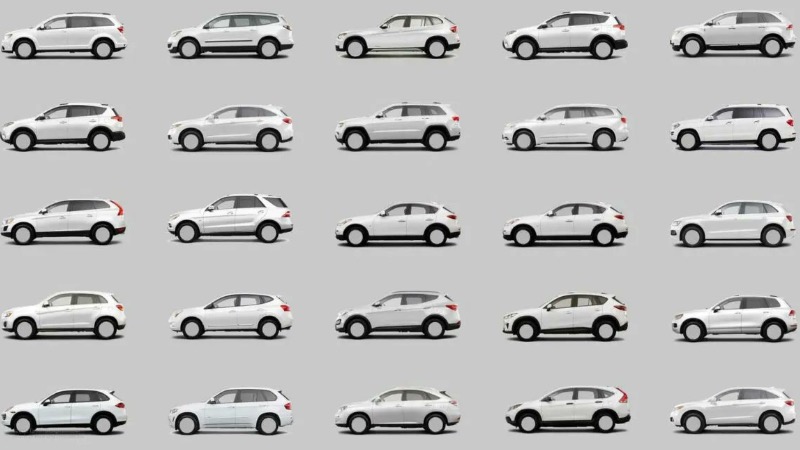
All the factors listed above have came together to not only puff up the modern car, but to also make them all look the same:
While there has always been large vehicles for tasks that require them, the normalization of large vehicles for basic passenger transport may still benefit some drivers. Men who are short can compensate by owning a large truck. Normalization of large trucks can allow these men to compensate for their physiological shortcomings while also not standing out while doing it.
Regardless of size, modern cars are enslaving owners in a dystopic technocratic takeover.
Modern cars produced since the mid-2010’s carry Trojan horse technologies that owners are now becoming aware of. Technology that can control where and when drivers are allowed to drive, track driver’s eyeballs, record occupant conversations, collect genetic and health information, biometrics and weight of drivers and passengers, causes auto insurance premiums to be increased and even monitor driver’s sexual activity.