 Image Credit: @MCC_Brussels / X screenshot
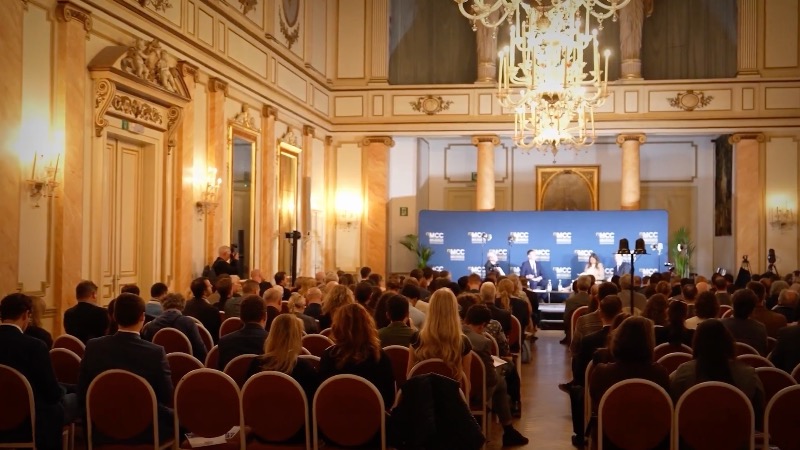
The first day of the Battle for the Soul of Europe brought together political leaders, academics, and thinkers in the EU’s capital who, for hours, dissected without hesitation the identity crisis the continent is experiencing. From cultural erosion to the growing power of the European Commission, from the rise of patriotic movements to the migratory challenge, the meeting made clear that Europe is at a historical crossroads and that the time to prevent its drift is running out.
The opening session set the tone for the day. The organisers warned from the stage that the conference should not become a collective lament, but an exercise in strategy. “We don’t want this to be simply another conference for complaining. We want everyone to answer one question: what comes after the next patriotic victory?” Jacob Reynolds, Policy Director at MCC Brussels, stated in his opening remarks, urging attendees to think in concrete scenarios of power and not only in accumulated cultural defeats.
That same spirit carried over into the speech by MCC’s Director General Zoltán Szalai, who defined the current moment as a battle “for freedom, faith, culture and sovereignty,” pillars that, in his view, European elites are eroding through new forms of censorship and social engineering. “We cannot allow political correctness to censor reality,” he warned, quoting Jordan Peterson to remind us that “thinking implies risking being offensive.”
The first major turning point of the day came with Václav Klaus. The former Czech president, one of the most influential conservative voices on the continent, even dismantled the premise of the event by asserting that “Europe does not have a soul” as it is usually defined, at least not in the political sense in which the term tends to be used. His criticism pointed in another direction: the systematic confusion between Europe as a civilisation and the European Union as a bureaucratic structure. “Europe is a conglomerate of nations; the European Union is an artificial construct,” he argued before denouncing “centralised planning,” the “green ideology,” and the advance of policies that, in his view, resemble far too closely the regulatory mechanisms of twentieth-century communist regimes.
The political debate took shape in the panel addressing transatlantic relations. Portuguese MP Pedro Frazão spoke without metaphors about a continent that has lost self-confidence and now lives in military and energy subordination to the United States. “America is the adult, and Europe is the dependent teenager,” he stated, before listing the values that, in his opinion, are re-emerging across the continent: firm borders, family, nation, rejection of gender ideology, cultural security, sovereignty, and Christian faith. “Our values are winning elections,” he said, sending a message both to his audience and to the governments in Brussels that “still refuse to see it.”
The historical dimension of the debate came from German professor Benedikt Kaiser, who reconstructed the ties—and the growing divergences— between Europe and the United States. He recalled that both share Roman, Christian, and philosophical roots, but warned that recent decades have driven both models sharply apart, especially due to Europe’s lack of a strategic horizon. “Too many Europeans prefer a comfortable life over political responsibility,” he lamented, in an analysis directly linking this trend to the continent’s economic and military decline.
The economic crisis was also at the centre of the debate. Norwegian entrepreneur Andreas Svanlund described a Europe that no longer innovates but survives through financialisation. “We follow the marked trail, but the trail is broken,” he warned, in a speech combining economic diagnosis and natural metaphors. For Svanlund, Europe must once again reward innovators—the “wandering ants,” as he called them—rather than the managers of a system that no longer produces real prosperity.
One of the most anticipated and conceptually dense speeches came from American philosopher Patrick Deneen. His analysis targeted the moral core of Europe’s crisis. Deneen argued that the continent has replaced the old deadly sins with a new moral order based on ideological prohibitions: nationalism, colonialism, racism, sexism, Christianity, conservatism, and any form of moral judgment. This new system, he said, turns Europe into a civilisation paralysed by guilt. “Europe does not need less pride, but a properly oriented pride,” he asserted, warning that the continent lives in a state of “institutionalised self-hatred” that leaves it unable to defend itself culturally.
Toward the end of the day, Polish philosopher and former MEP Ryszard Legutko offered a structural analysis of the European project. He described the EU as “an enlightened oligarchic system” operating under a democratic fiction. “The EU speaks of representation, but systematically marginalizes the parties it calls populist,” he argued, stating that the integration process—from the Monnet method to the rulings of the Court of Justice—has been built upon “masking” the true scope of the federal project. “The European Union was conceived with errors of origin, not only of management,” he concluded.