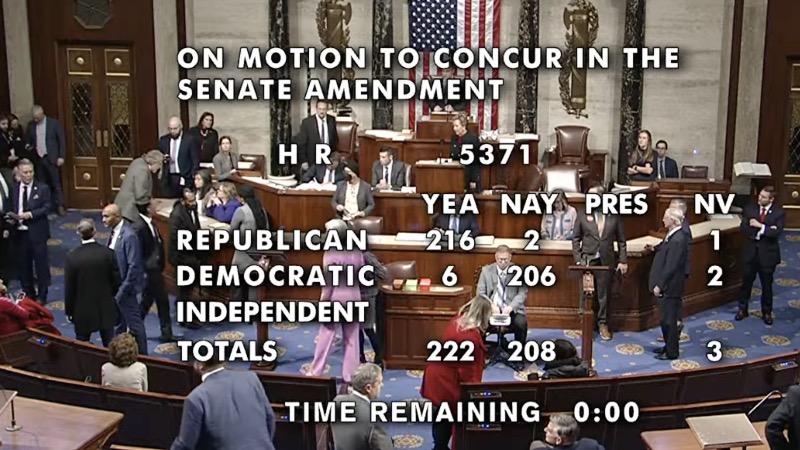
 Image Credit: Fox News / Youtube Screenshot
On Wednesday evening six House Democrats voted with Republicans to end the government shutdown which has gone on for 43 days, the longest in the nation’s history.
Watch the full legislative drawn-out-battle here.
Republicans previously voted 14-times to end the shutdown but there were not enough Democrat votes to secure the spending bill needed to reopen the government. The 222-209 vote saw 6 Democrats vote to reopen the government and 2 Republicans vote against the measure
“But six Democrats bucked their own leadership to help reopen the government after 43 days: Reps. Jared Golden (D-Maine), Marie Gluesenkamp Perez (D-Wash.), Adam Gray (D-Calif.), Don Davis (D-N.C.), Henry Cuellar (D-Texas) and Tom Suozzi (D-N.Y.),” The Hill said.
The plan that was finally agreed to combined a continuing resolution which keeps the government funded through Jan. 30 with a three-bill “minibus” (taken from the word omnibus) package. At that time negations on keeping the government open will again need to be had. The Minibus provisions are good until September 30 however.
The deal reached Wednesday night will also reinstate federal workers fired during the shutdown (which was intended to be part of draining the swamp) and guarantee them back pay. It also prevents further layoffs through the end of January.
Despite this, the reopening deal was not a Democrat win.
“Most Democrats are firmly against the funding package, while Republicans are largely supportive,” ZeroHedge said.
Wednesday’s deal also excludes an extension of advanced Obamacare premium tax credits after Democrats caved on that at the 11th hour.
ZeroHedge broke down the mood on the Hill:
There was some drama when Rep. Marie Gluesenkamp Perez (D-Wash.) shocked and dismayed colleagues with a rogue effort to condemn retiring Rep. Chuy García (D-Ill.) for effectively ensuring his chief of staff would succeed him in Congress.
But other than that it was the usual moments for House Dems to conjure ‘TikTok’-size monologues about how evil Republicans are.
Infowars detailed on the initial instance that kicked off the battle which shut down the government.
On September 24 President Donald Trump pushed back on the Democrats demanding massive amounts of money for radical left-wing agendas in return for avoiding a government shutdown. He canceled his meeting that day with the Democrat Party’s leaders, Sen. Chuck Schumer and Rep. Hakeem Jeffries.
That meeting was intended to make a deal to prevent the federal government shutdown, but the demands were just far too radical in nature for Trump to even consider.
That deal would have seen free healthcare for illegal aliens, open borders, trans-genital removal surgeries on children, free cash for failed liberal media outlets and the ability to leave dead people on the Medicare rolls so criminals can continue to collect fraudulent payments.
ZeroHedge also laid out what comes next:
Once the funding package passes, Johnson plans to send members home for the remainder of the week. The speaker has warned of “long days and long nights” ahead – but not this week.
In the weeks to come, Johnson faces three major challenges:
- A Short-Term Fix: The new continuing resolution extends funding for just 79 days, meaning another shutdown fight looms early next year. Negotiators must still resolve disagreements over contentious appropriations bills covering Labor-HHS, Commerce-Justice-Science, Defense, and Homeland Security.
- Health Care Deadlines: ACA premium tax credits are set to expire at the end of the year. Johnson will need to present a credible health care reform plan to prevent moderates from joining a discharge petition to extend the subsidies. Passing major health legislation within 49 days — during the holiday season — is a tall order.
- Intraparty Disputes: Conservative members including Reps. Chip Roy (R-TX) and Austin Scott (R-GA) are pushing to repeal a provision in the Legislative Branch appropriations bill allowing senators to sue the government if their phone records were obtained by the Justice Department.
Adding to the tension, by the end of the day, the Jeffrey Epstein records discharge petition is expected to reach 218 signatures, triggering a full House vote on whether to force the Justice Department to release the complete Epstein files. Vulnerable Republicans could face political blowback if they oppose the measure.
If tonight’s vote proceeds as expected, the federal government will reopen for the first time since Oct. 1 – but the brief reprieve may only set the stage for another high-stakes funding showdown early next year.